

The agora, the gospel, and a 1339 fresco of good government: the sacred roots of shared city life.
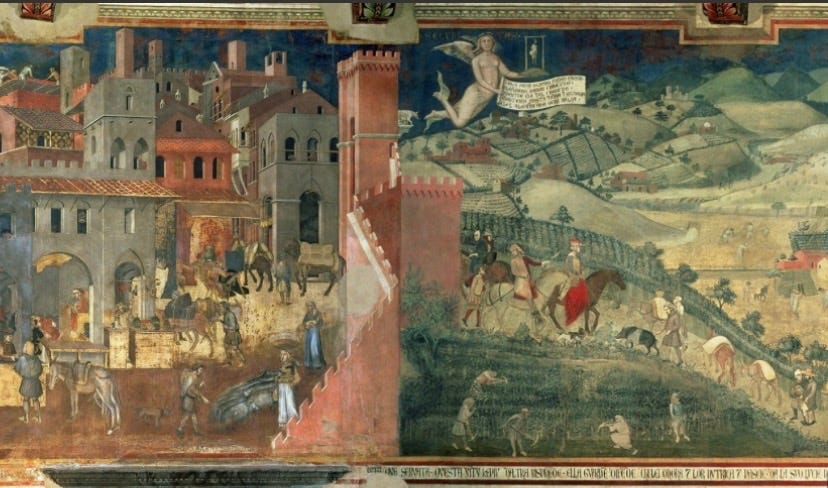
(Lorenzetti’s the Effects of Good Government fresco.)
We have seen what “the urban commons” is, how it dies and at Ephesus what remains of it when a city has finished dying. We turn now from the ruined agora to the living one: to the deepest origins of the commons, in the public square of ancient Greece, in the gospels, and in the painted walls of a medieval Italian city hall.
The Fathers of the Commons
All the great historical cities of the western world have several societal rooms which make up “the urban commons.” Each of these urban spaces plays its own individual social function, while at the same time their particular organization helps to make up the larger urban room which is the city itself.
Names such as Miletus, Athens, Thebes, Sparta and all the Greek city-states must be duly honored as the fathers of “the urban commons,” which often became, and were encouraged to become, something much more than commercial farmer-markets. The Hellenic World inspired the connotation that the city-square is our public living room; an urban room which may be used by the people as a theatre stage and as an academic classroom, for their leisure and for their enterprise.
The story of Socrates, which marks the beginning of the great political conversation of the western world, points to the intimate relationship between the invention of “the urban commons” and the birth of the moral philosophical tradition. It’s worthwhile to remember that the Greek word “idiot” signifies someone who doesn’t understand politics.
What Socrates Saw
The Greek city-square, the agorá, was the maternity-ward for the midwives of the mind, also known as the Socratic school of philosophy. What did Socrates see on that city-square? What was the insight of Socrates?
If we stand with Socrates and his friends in The Piraeus of Athens, reading from the beginning of Plato’s Republic, we might gain an insight as he slowly builds up his city in speech. Since the agorá is the public room which all the citizens share equally, it also becomes a space for our moral awareness, of ethical norms and etiquette. It becomes a classroom, a school of life, where we learn that not only noblemen, but even roaming gangs have a social etiquette.
We learn that Socrates was not a man who sat alone in his home by his writing-desk, that he preferred to walk among the people on the agorá of Athens. In contrast to St. Paul, he didn’t present any doctrines there; he preferred to talk, to engage in conversation. But he wasn’t known as a public orator, being quite content to ask people questions as he met them.
The philosophy of Socrates rested in the insight that facts and figures neither inspire conversion nor conversation, as our conversation partners will perceive us as threatening, thereby entrenching and fortifying themselves in their points of view. In order to interact creatively on the public square, the Socratic method of nonthreatening dialogue is the only path of communication.
Nonetheless, he was condemned to death by the Athenian democracy in 399 B.C. Yet his cause endured and his public dialogues were preserved by Plato, as they’ve also lived on within countless conversations upon numerous squares throughout the world.
The Marketplace in Scripture
St. Matthew writes in chapter 20 of his gospel that Jesus likened the City of God to a householder who “went out about the third hour and saw others standing idle in the marketplace,” in order to hire those unemployed men on the city-square to work in his vineyard. The marketplace of the city and the marketplace of our lives is a common theme of western civilization.
In his famous painting “The School of Athens,” in the Vatican Museums, Raphael depicted Plato and Aristotle walking under classical arches amid the marketplace of ideas, as two conversation partners on their daily stroll through the agorá. Theological doctrine, political dispute and moral philosophy fight for air in this painting, just as they have done within every city-square throughout history.
A little research into this phenomenon will quickly lead us to some obvious conclusions: an exchange of intellectual and existential experiences presupposes a conversation, this conversation presupposes a meeting between persons, this meeting presupposes a comfortable meeting-place for these individuals. Turning this little induction on its head, we may deduce that the city-square is an indispensable part of the urban landscape and of our philosophy of life. What the maternity-ward is for the potentiality of motherhood, “the urban commons” is for the potentiality of the citizen.
The Room at the Heart of the City
The agorá, the piazza, the plaza, the praça, the place, the platz, the torv, the torg, and the square is the central room inside every city or neighborhood, because it makes space for something that lies at the heart of our human existence.
The square is in the middle of our towns, where we would traditionally find both City Hall and the Cathedral, because both contain some part of our civic lives within themselves. The square is a room with many shapes, but it’s also an institution which makes space for something important. Its urban quality consists in what very quantifiable good the room makes space for.
It’s not enough that it’s a room; a city must also embrace us maternally, as we must welcome it, through a civic exchange on “the urban commons.” Failing to do so results in a fatal mistake.
In St. Matthew’s gospel, we find Jesus’ lament over the city of Jerusalem. He says: “How often have I desired to gather your children together as a hen gathers her brood under her wings, and you were not willing.” This is one of the few instances where God is given female characteristics, but if the City of God is for the children of God, this analogy makes perfect sense.
Good Government Painted on a Wall
The city has an almost maternal instinct in how it wishes to take care of its citizens. One of the most striking presentations of this familial relationship is a painting inside City Hall, the Palazzo Pubblico, by the Piazza del Campo in Siena, Italy.
Ambrogio Lorenzetti painted a series of frescos in the year 1339 where the subject matter is civic rather than religious. They go by the name Allegoria ed effetti del Buono e del Cattivo Governo, which means “The Allegory and Effects of Good and Bad Government.” The most importance is the fresco entitled “The Effects of Good Government,” which summarizes how Christendom understood man and urbanity.
First, the artist has depicted the existence of a harmonious relationship between buildings and people, between citizens and architecture. This is an urban ideology. The city is made for man, not man for the city, as Jesus said, “the law was made for man, not man for the law.” Likewise, it is clear that good government is made for man, not man for good government, for if man were virtuous there would be no need for good government.
The next harmonious relationship which we notice is the balanced interplay between the city and the countryside, where urban culture is in harmony with its surroundings. There is a wall between them, but the bridge between them is the city-gate. This is an ecological ideology. Not only does the city achieve a balance with its natural surroundings; rural culture is itself in harmony with the rhythms of nature.
As we can see from these examples, contemporary obstacles to balance and unity within our societies would be greatly enriched by looking to the medieval renaissance.
Naples: Where the Sacred Meets the Civic
The Piazza del Campo in Siena is only one of countless squares in Italy, which are all very different from each other, yet all express an aspect of this ideological harmony. Naples may be the third largest city of Italy after Rome and Milan, but her squares tend not to be as famous. Perhaps the reason rests in their preservation of an uncomfortable medieval atmosphere of cacophonous sounds and pungent smells. Local priests will even confide that they minister to a city still divided between patricians and plebeians.
Rising over the rooftops of this metropolis is the Cathedral on Piazza del Duomo. The facade is a formidable mixture of art and architecture, making it difficult to know where one style ends and another begins. But it’s not so strange. The whole structure speaks of Christendom’s development from a marginalized whisper on the bay of Naples into the proud voice of this southern city. The mornings are reserved for the Mass-goers, while in the afternoon the square turns into a soccer pitch for the children of the neighborhood.
Beyond the square, the Cathedral protects a chapel with the relics of their patron saint, San Gennaro. The chapel is the property of the city for its people, not of the church for its faithful. The border between the church and the city is marked at the chapel entrance by a large iron gate crowned by a bust of San Gennaro, and in the floor is the seal of Naples before three altars. An innumerable collection of gold, silver and jewels, donated by the faithful as votive gifts of thanksgiving, are kept in an adjacent room.
Here the interplay between the city and the church is underscored further, for while the treasures belong to their patron saint, his miracles belong to the city for its people. This relationship reflects an old tradition, for in Catholic social theory the church magisterium and the city government are separate in their functions but not in their principles. Therefore, the result of this unique arrangement is not that the city has imposed its power over the church, but that we can read the Cathedral as another chapter in the imaginative use of “the urban commons.”
Whatever its effect, this simultaneously holy and secular space underscores that a societal room has to have a story attached to it. Something has to happen there. It has to be about something.
The Square as Theater of Life: Piazza del Plebiscito
Naples was, between 1282 and 1860, primarily ruled by the Spanish royal houses, and the Andalusian atmosphere is evident in many of the older quarters. The most significant break from Spanish rule was the Napoleonic parenthesis between 1806 and 1815. The greatest square of Naples was built during this era, known first as Largo del Palazzo, built to celebrate the return of the Spanish kings.
It was then renamed Piazza del Plebiscito due to the plebiscite balloting held here in October 1860, which annexed the defeated Bourbon Kingdom to the Savoy Kingdom, officially uniting the peninsula to become the Kingdom of Italy. Piazza del Plebiscito thereby became a majestic building project trying to combine the political ideology of a royal restoration after the Napoleonic Empire with Italian nationalistic sentiments within Neapolitan life.
This has given this particular square a place in the unfolding story of the city, which is a story about populism and power, about the role of the people within a monarchy. All kinds of local and national celebrations, pregnant with symbolism, from Christmas pageants to political balloting, have taken place here. Two bronze statues designed by Antonio Canova stand guard in the middle of the square, one dedicated to King Charles III, the other a representation of King Ferdinand I, who each sit on bronze horses.
During the day, if there’s nothing specifically happening on the square, Piazza del Plebiscito is still filled with visitors on their way to various parts of the city, lending a noble backdrop to whatever is on their schedules.
The architects stole freely from Gian Lorenzo Bernini for this project, combining themes from two of the most famous squares in Rome: the piazza San Pietro and the piazza Rotonda. A wide curving colonnade embraces the square, similar to the great colonnade before St. Peter’s Basilica, lending a maternal intimacy to an otherwise spacious square. The colonnades flank the Basilica of San Francesco da Paola, built to faithfully mimic The Pantheon in Rome. They also connect the surrounding palaces with this public square, emphasizing a gradual transition between outside and inside.
The square even slants slightly upwards as in an auditorium, giving the overall impression of an operatic theatrical setting. But it’s not merely a backdrop for a rehearsed performance, it’s built for the everyday stage of life, as a very Neapolitan interpretation of the societal room.
We can enjoy this play of life while sitting down at the celebrated Gran Caffè Gambrinus on the north end of the square. Whether we decide to order another espresso at our table or to keep walking over our common floor, we are an equal part actor and spectator upon “the urban commons.”
Pax et Bonum!
C.W. Höjer
This closes a short series on the urban commons. But the argument only lives when it meets a real place. I have been testing it on the road this year: on the worn walls of Youghal, inside the open squares of Italy, in the emptied streets of Ephesus, along the two-continent ferry lines of Istanbul. If you would like to walk these cities with me, the dispatches are here, and there are more to come.
Thank you for reading Good Cities!