

Urban centers like New York, New York, Chicago, Illinois and Los Angeles, California, have been labeled as the first cities ever built for the automobile, which has since influenced cities all over the world. Whether that phrase is historically accurate or not, The United States of America embodies the idea of urban exceptionalism and the attitude that citizens can love cars better than anyone else. Yet, even cars wouldn’t mean anything without the people inside the automobile, or without our destination towards a place inhabited by other people.
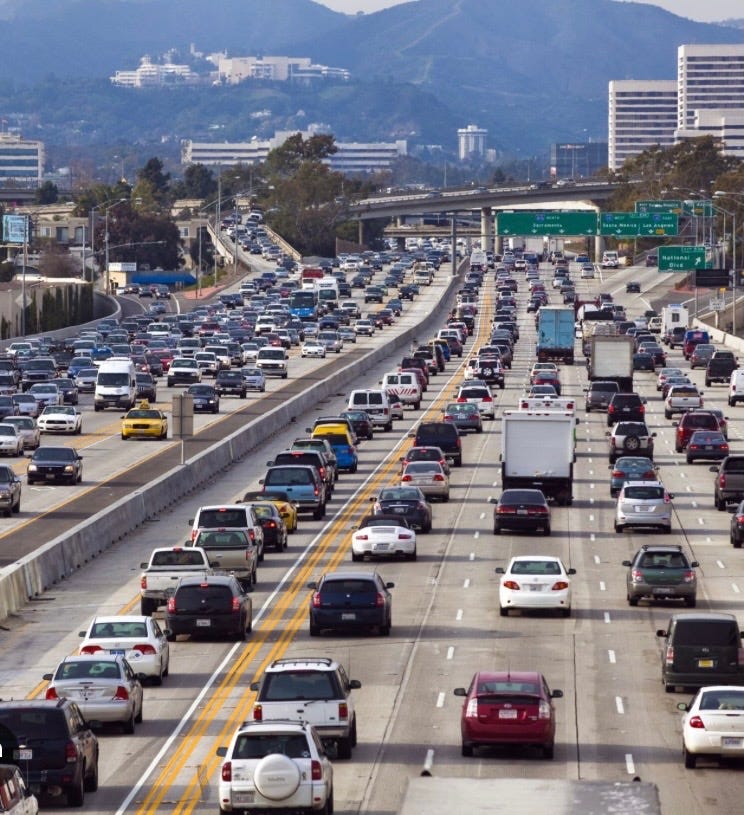
Millions of men and women live in these places with fabulous nicknames like the The Big Apple, The Windy City, or, indeed, The City of Angels, yet we are not angels, nor are we devoid of material necessities, as we need both cars and roads in our modern world. But the greatest invention of mankind is not the self-moving vehicle but our urbanity, or the self- governing city for self-governing people, what the Greeks called their Kosmos and Polis, wherefrom we derive our word “cosmopolitan.”
I found myself discussing these themes one day in The Paris of the Plains, which is the popular nickname for Kansas City, Missouri, on a park bench above Cliff Drive. It’s an American city in the Midwest which one might not automatically associate with great civilizational importance, until one contemplates its silhouette against the western sky from Scarritt Point. Preferably, one should arrive there in the fall, as a soft autumn light hits the Greek columns of The Colonnade above Kessler Park, after Mr. Kessler who dreamed of a city within a park in the City Beautiful Movement.
Children were playing outside in the fountain and running across the square, jumping in and out of the classical columns, which was a good environmental reminder of where these architectural archetypes were once born. Namely, within an ancient Near-Eastern culture called the Middle East, which the Hellenic expansionism under Alexander the Great spread far and wide, which the Roman Empire transformed into a universal language of imperial ideology.
We talked of many things that day, as friends tend to do when they get together, especially about life within our western cities. We asked ourselves why the little neighborhood church, in Columbus Park, not far from us, nestled between a cafe and a restaurant in a laidback atmosphere, reminded us more of a little town in central Italy than of a bustling neighborhood in the American Mid-West.
The great settlers of the American Wild West were able to develop thriving commercial businesses across this land through their entrepreneurial enthusiasm, but could they have built a cosmopolitan culture if there wasn’t the appropriate soil in which it could grow? The old European urban ideals could spread across The United States by horse-carriage and train-carriage, but would it have rooted itself within the new American people if such urban archetypes weren’t already imbedded in our human nature?
We talked about why Kansas City has more in common with Paris, than Kansas City has with a farming town in Missouri, or Paris has with a countryside village in France. Fundamentally we were asking ourselves why it’s the city and not the nation which is the transmitter of our traditions, and why our contemporary life of electric wonders, so full of confidence and vitality, still seems to cower in awe before the wonders of the ancient world.
Fast cars, filled with fast food, circled around us where we sat on our bench, discussing the slow movements of time and ideas. As we would try to locate the earliest precedents of our western urbanity, we had to think far back into the recesses of our memory, to the geographical areas called Syria and Mesopotamia, before written history.
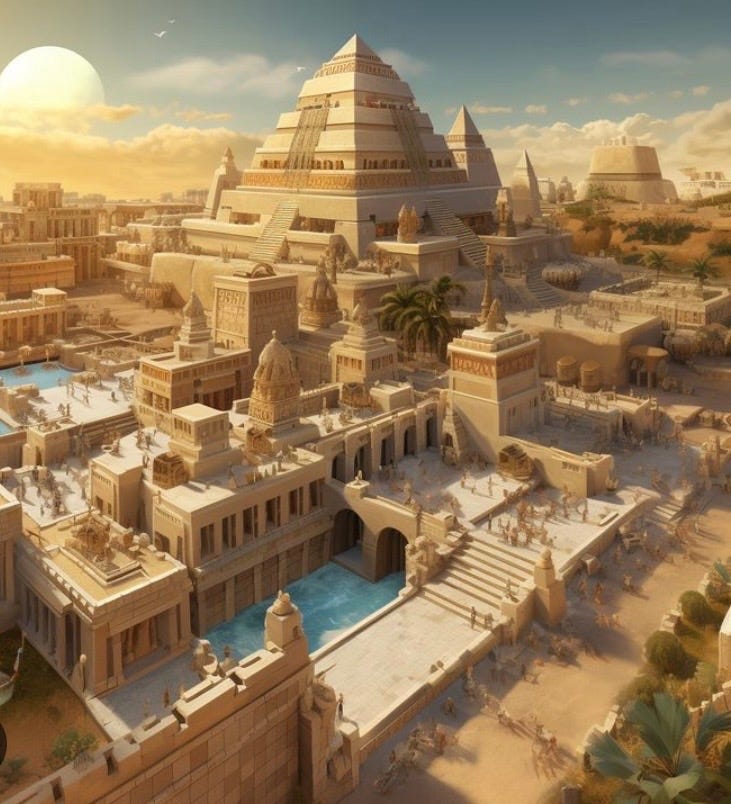
The Greek columns of The Colonnade became mere temporal embryos in comparison. We had to fumble our way through a dimly lit library of arcane place-names such as Jericho and Ur. We had to engage in mental acrobatics to imagine the grandeur of Babylon, supposedly the largest city ever built on earth. We had to picture the Phoenician fleet landing on the shores of Africa to found the city of Carthage some nine centuries - or perhaps many more - before Christ.
We thought back to some fruitful travels we had made throughout the classical world, where we had walked with Hesiod through Arcady and swum with Homer in the Mediterranean. We felt that we could never exhaust the wonders of the Aegean world. We were left peering across that wine dark sea towards famous cities like Knossos on Crete, Mycenae in the Peloponnesos - these various ships-of-state, with their white sails spread wide, skimming the whitecaps, cutting towards their goal. To try to comprehend our urban heritage is akin to sitting along the breaking surf, trying to hear the faint echoes of civilization from within the cave where Zeus was born.
Reading the histories of Herodotus, which tell of the Persian wars in the fifth century before Christ, we can at least begin to make out the urban silhouette of Athens, which would soon reach its peak under Pericles. When he ascended to his leadership position as “The First Citizen of Athens,” Knossos had already been a ruin for one thousand years, and during the same decades the famous Temple of Saturn was being erected in the Roman Forum. Today its base and eight remaining pillars can still be viewed, very picturesquely, from a lookout point on the Capitoline Hill.
As we turned our heads from our bench in Kansas City and lifted our heads towards the Greek columns of The Colonnade, we wondered how long they would last. A grand city such as Alexandria in Egypt was founded by Alexander the Great in the year 331 before Christ, at which time Rome had already celebrated its four hundredth anniversary, Ab Urbe Condita, that is, “from the founding of the city” by Romulus. The city of Constantinople, which was founded in Byzantium by Emperor Constantine, the first Christian emperor, seemed far too modern to mention. The so-called Middle Ages of Christendom which followed upon the reign Constantine the Great, had baptized an urban language which was far more ancient than any Cathedral-town of Europe to be worthwhile mentioning.
Instead, we had to travel far back into more oriental lands to find our western heritage, East of Eden in fact, to the Land of Nod where the fratricide Cain, Adam’s son, built the first city on earth. But why? The annals of history cannot give us an explanation. St. Augustine tells us in his book “City of God” that a civic community is nothing else than a multitude of men bound together by some associating tie. So perhaps Cain, as his family increased in number, was less of an urban planner and more of an urban provider…!
Pax et Bonum!
Wilhelm Höjer
I love a good Augustine quote! And I'm going to think on that one for a bit. I feel in Kansas City our associating tie is, potentially, our sense of local neighborhoods organically organizing to create community spaces, like at PH Coffee or the Colonades.