

Part 3 of a 3-part series on the origins and nature of urban life
Sitting in Concourse Park in Kansas City, watching our son run in and out of the fountain pool, we could see the pillared walkway of The Colonnade behind his little scurrying body. Those pillars were based upon earlier examples in Rome and Athens. This colonnade had been raised by American hands with Roman ideals, which were based upon Roman hands with Greek ideals.
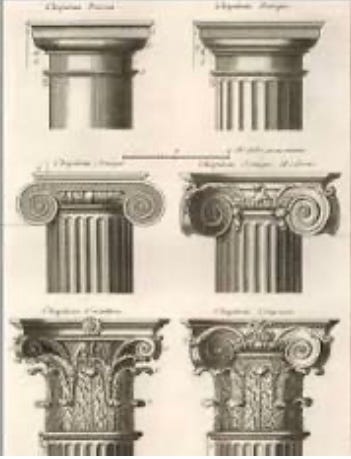
They pointed to a tradition, to an architectural language. For at least three thousand years these particular load-bearing pillars called columns have not only been constructed according to a very similar design, but have been a necessary part of all western cities. Since Mediterranean antiquity we’ve consistently been playing with four or five types of columns, which through an ever expanding geographical reach have transmitted to us the same lesson: this is how a church or a theatre, a law court or a university is meant to look like.
These ancient columns have been reused and reinterpreted from Rome to Constantinople, from Moscow to Washington, as a timeless language. They are true signs of a good social order and the symbols of a beautiful empire. The Roman State finally gave them a standardized form, a precise aesthetic definition, which still allows them to be universally understood through the mother tongue of every city: architecture.
From Log to Column
Anyone blessed to be a tourist in the southern Mediterranean can sense that columns were once nothing more than robust logs erected to hold up a simple canopy. Certain Doric columns which make up the temples of Paestum, below Naples, resemble thick palm trees upholding a temple roof.
After all, there are only two reasons why anyone should wish to erect a roof in the Middle East or the Mediterranean: either to protect oneself from a scorching sun, or to keep oneself dry from a driving rain. There are reasonably only two ways to erect a roof as well—either by latching it onto a large tree, or by supporting it on some wooden posts. By a simple historical deduction, the column is now invented.
If a group of people wishes to live in the same area, due to its favorable conditions, but under separate roofs, they soon develop a type of tent-city. Further, if these early tenants should wish that their plot of dirt become a more permanent residence, the area has to be maintained according to some useful rules. Through another historical deduction, the urban aesthetic is now invented.
If this tent-city continues to grow and expand both in its population and geographical area, but without losing its favorable qualities, then its citizens must think in both practical and aesthetic terms. Through a further historical deduction, a guiding norm for urban development is now invented. To enforce such a norm, management is also invented.
Columns as Cultural Products
As we let our eyes span our view from the columns of The Colonnade to the columns of The Kansas City Museum between the trees on Gladstone Boulevard, to the columns of The Catholic Church of St. Anthony around our backs, we could deduce that they not only carried the buildings physically, but they carried the city metaphorically and symbolically. This was a poetic insight, with a historical reality.
For these columns, which are all around us within western civilization, tell much of the story of our urban development. In the beginning, the column was a simple weight-bearing construction, just as the city was a simple collection of tents. The material for these columns quickly changed from wood to stone, cut from granite or marble quarries.
This was not out of extravagance, but rather tragically out of poverty. The ancient Greeks had so ravaged their environment that the great woods and leafy ridges which had once graced their hills were now piles of timber and their shimmering meadows grazing grounds for goats and sheep. The subsoil was then left unprotected and directional winds blew their wooded islands, literally, into the sea. So the ancient lumberman soon become a stonecutter.
In other words, the Greek column was a natural product of their land before it became a cultural product of their civilization. Likewise, the first city was formed in nature, upon a plot of dirt or a flat plateau, before it became a cultural archetype.
Greek Progress and Natural Harmony
In contrast to the Babylonian and Egyptian civilizations which retained very static cultures, the Greeks fostered a real enthusiasm for the idea of progress. As theology tends to serve as the starting point for cultural perspectives, it’s important to see this aspect reflected in the Greek myths, which were always speaking of rebellious sons overthrowing their fathers.
Yet throughout the development of the Hellenic column and its architectural uses and designs, the Greeks remained loyal to their natural landscape. Perhaps because they had once destroyed their original environment due to technical progress, they had placed their myths in nature, rather than in cities, to protect what was left.
In the classical world we notice how the Greeks constructed their buildings within an open landscape. These cities were constructed around temples and theaters made for pious citizens, but they were also constructed in a way that honored the nature in which they lived. These structures showed reverence to the light that illuminated their world and to the air that they breathed into their lungs, in deep intimacy with the earth they tilled for cereals, olives and wine.
They raised these columns to be transparent walls against green valleys and craggy cliffs, as a window onto creation. They formed the space between the columns to be both inside and outside, playing upon the harmony that ought to exist between a building and the place in which it is constructed. Following generations could then produce a normative pattern for subsequent cities; in other words, they had been provided with a measure of the urban Kosmos to determine how they might define the Greek Polis.
Archetypes and Forms
This power of cultural progress generated various discoveries within our western civilization across many centuries. Yet alongside this idea of development there’s always been a conservatism, or rather a change within a continuity. Through the evolution of Tuscan to Doric, Ionic and Corinthian columns, a column remained a column from the plane post to the composite column, just as a city remained a city and a chair remained a chair. The original forms for these things were developed not to be different, but to be the same.
The original forms, seen in all the visible things, discovered and recognized at specific moments of human history, stand as timeless objects for our imagination, our thoughts and our intellects. They also build upon each other in a very organic way, so that a specific solution for a very practical problem then serves as an aesthetic norm, as a guiding light, for the solution of another very specific problem.
Whenever we’re able to recognize a staircase as a staircase by a combination of its form and function, we’re entering into this reality. We can recognize a staircase without ever needing to climb up or down its steps, while at the same recognizing that we don’t need to use it for this sole purpose. A staircase remains a staircase even if we use it for theatre seats, or a chair remains a chair even if we use it as a table.
When a staircase doesn’t need to convince us of its function as a staircase, it’s because mankind has a universal understanding of its recognized form. Within our cities it’s never a question of merely the functional shape, or the mere functional form of any one thing. Rather, it’s a question of the aesthetic forms, of the objective shapes, which reside so deep within our rational capabilities that we might call them archetypes.
Roman Unity Through Urban Form
After the long Punic Wars ended with the sacking of Carthage in 146 B.C., the Romans realized that they could better spread their empire by founding new cities of their own than by destroying the old cities of their enemies. This change meant that cities achieved a monumental significance and a greater normative quality. They became political icons of the urban life, making their most prominent architects, such as Vitruvius and Apollodorus of Damascus, synonymous with their empire.
The Roman city was carefully molded after an established formula. They followed an identical urban plan with two intersecting main axes inside a grid system of streets organized around a central square. A Roman city was therefore recognizably Roman, whether it was established in Hispania, Brittania or Gaul. The Romans founded perennial urban centers such as Toledo, Paris and London.
Their ideology was unity within pluralism, where all nations could be Roman, living under one Roman law with Roman rights and Roman duties. It was an ingenious philosophy which could incorporate every conquered tribe into one body politic. A single empire originated from one city, the urbis, which had become one world, the orbis. The city was the weapon, or to borrow a modern phrase, “the medium was the message,” whereby urbanity was the preferred strategy of colonialism.
The Greco-Roman column was the unifying architectural principal, not merely because it was the most practical way to carry a roof, but because it was an indispensable component of how a city ought to look like—it helped to make the city into a city. The column quickly became a concept within western civilization by which we measured our nobility, from the Parthenon to the Pantheon, from the Cathedral to the City Hall, from The Apostolic Palace to Buckingham Palace. It was the backdrop to our culture, neatly framing our lives and our conversations.
From Ancient Columns to Modern Skyscrapers
The longer we sat by The Colonnade above Kessler Park and the Kansas City skyline, the clearer we saw the similarities between the 6th century B.C. architects of The Acropolis and the 19th century architects of the world’s first skyscraper in Chicago, the financial hub of the American Wild West. For though they were separated by space and time, they were somehow united by natural law in their urban solutions.
It was the ancient architects of Greece and Rome who invented the apartment block over two thousand years ago. Since they lacked some of our modern technological advances, they seldom built buildings taller than four floors. In America, it was never due to an aesthetic preference that the architects of the Industrial Age began building skyscrapers. There were some natural conditions to live by and new technologies could be utilized to solve some of the pressing problems of the day.
After the Great Fire of 1871, Chicago had its area redesigned in a new grid-network requiring innovative solutions. Chicago had a stable foundation lying on a solid flat plain of limestone and the architects of Chicago had access to the newest technologies within engineering and construction, which utilized elevators, electricity and fireproofed iron.
Seen in this light, the high-rise building was an urban innovation which developed naturally out of certain spatial conditions at a certain time in history for specific human needs, not unlike the ancient column. After the building boom of the early Twentieth Century and especially after the two World Wars, the skyscraper became a modern form, a new normative trend, which other architects and urban designers translated into their own contexts.
This was not due to any pressing social or environmental need, but because the high-rise building had become the universal symbol of the modern city in the Age of International Technology. These skyscrapers of the International Style stand alone on individual plots of land, rather than as a part of a row of high-rise buildings, to promote a more open and transparent society, universally applicable, without reference to any vernacular designs.
The Question of Modernity
These norms have been critiqued as totalitarian and elitist in nature, which are modern norms that forget, perhaps, that buildings are made for people, not people for buildings. The result is that skyscrapers can only make a city as modern as its people allow it to become. This contemporary critique among architects and political philosophers has been called post-modernism.
The city speaks to us through its forms—through columns that have carried civilization for three millennia, through streets that follow patterns first laid by Roman engineers, through squares that echo the agora where democracy was born. Understanding this language, this architectural grammar that transcends time and place, helps us distinguish good cities from bad, human-centered design from ideological imposition.
The question for our age remains: Will we continue to honor the timeless forms that have served human flourishing, or will we break with tradition in ways that forget that cities, like columns, must serve the people who inhabit them?
Thank you for reading this series on the origins and nature of urban life. What cities do you find speak this ancient language most clearly?
Pax et Bonum!
C.W. Höjer