

A dispatch from East Cork, where Youghal still remembers its walls and Ballymaloe still remembers its fields—two forms of the same idea
The road from Ballymaloe to Youghal runs east through hedges, wet fields, and small settlements that seem less arranged than grown. One has the sense, driving it, that East Cork still remembers how to belong to itself.
At Ballymaloe this instinct appears first through food. The gardens, the bread, the butter, the slow confidence of meals built from what the surrounding land can actually provide — all of it rests on the assumption that culture begins locally, that a place should know what grows there, what the sea gives, what the season allows. The undeniable achievement of the Allen family is not merely culinary. It is civilizational in miniature. They have built a world from the logic of the local and proximity.
A few miles away, Youghal expresses the same instinct in stone.
The Walls and the Estuary
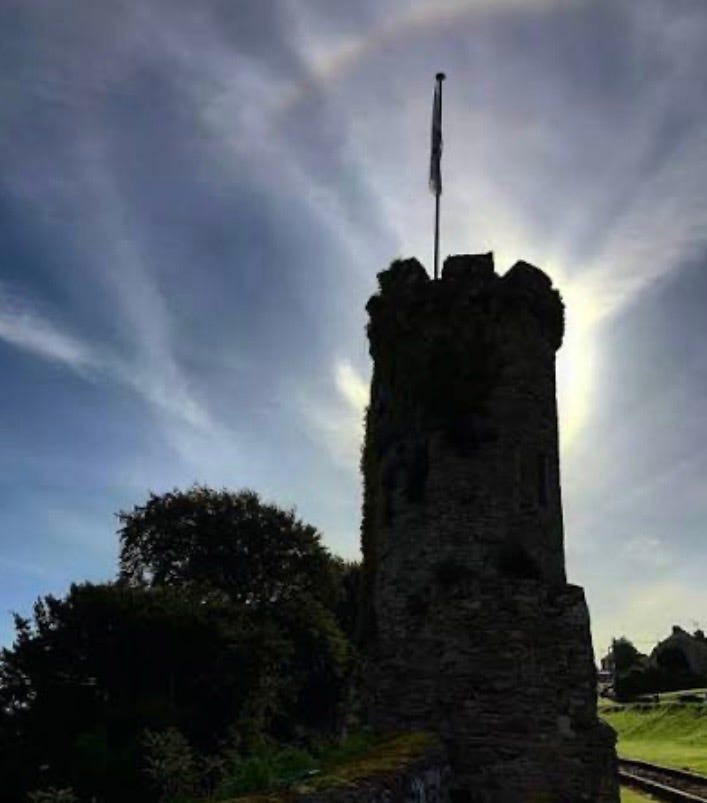
The old walls still stand above the town. You climb a narrow passage and suddenly the estuary opens beneath you: slate roofs, gulls, the slow width of the Blackwater moving toward the sea. Underfoot the wall is uneven, worn smooth by centuries of feet. Dating to around 1250, these are the most intact and complete town walls in the Irish Republic — nearly a mile and three-quarters of battlemented stone, curving from the Raleigh Quarter down toward the Clock Gate, with the Half-Moon Tower still standing to its full height along the way.
The town has modern traffic now, pharmacies, parked cars, takeaway signs. But the form remains. The walls still tell the town where it ends.
This matters more than modern people tend to understand.
A wall is not only a defense. It is a declaration that a place possesses shape. Medieval towns assumed that human life required boundaries in order to become intelligible. Outside lay fields, marsh, uncertainty. Inside lay market, parish, guild, memory, obligation. The wall was less about exclusion than coherence. I often think of the Lorenzetti frescoes in Siena, where the painted wall between city and countryside is crossed by a single gate—the wall defends, the gate welcomes, and the two are in conversation rather than opposition. Youghal makes that allegory literal, just as well as Siena, and lets you walk along the top of it.
St Mary’s
You feel this most strongly in St Mary’s Collegiate Church, nestled within the walls in the Raleigh Quarter. The wooden roof rises overhead like the hull of an overturned ship—fitting, in a port town that prayed for safe arrivals. Light falls softly along the stone. Monuments from vanished centuries still crowd the interior: the marble Boyle family monument reaching almost to the roof, an older carved stone bearing the etched outline of a Viking longship, and the chest from which Cromwell is said to have delivered a funeral oration in 1649.
Yet it is a smaller thing that lingers in the memory. Set beneath a pointed arch is a thirteenth-century double piscina, worn smooth by centuries of use. Here priests washed the vessels used at Mass, the water returning directly to the earth beneath the church. A narrow slit remains in the stone between the basins. For generations visitors have passed a finger through it and offered a prayer. The stone itself has become a record not of events but of repetition: hands reaching, prayers spoken, water poured away. Standing there, watching a child place her hand upon the same worn surface, it was difficult to know where memory ended and participation began.
One does not experience the building primarily as an attraction but as continuity. Founded around 1220, St Mary’s was built for the celebration of the Mass, and much of what gives the church its character still bears the imprint of that purpose. The piscina remains in the wall where priests once washed the vessels; the long roof still shelters a space ordered toward prayer. Centuries of religious and political change have passed through Ireland since then, yet the building endures, carrying traces of the faith that raised it.
Today it is cared for by Cork County Council while the Church of Ireland congregation gathers there each week. Whatever changes history has brought, the visitor remains conscious that these stones were first shaped by the sacramental imagination of medieval Christendom. The church survives not merely as a monument to the past but as a reminder that prayer leaves traces more durable than the generations that offer it.
The Clock Gate
Then there is the Clock Gate at the center of town, traffic still passing beneath it as it has for generations. It was completed in 1777 on the site of an older medieval gate, and for a time it served as the town jail — a beautiful thing built over a hard one, as so much civic architecture is. The old gate was never wholly removed because the town never entirely surrendered the idea that its inherited form meant something. Three clock faces look down over Main Street, all showing, reassuringly, the same hour.
Places That Still Know Themselves
Modern development usually begins by dissolving such limits. The bypass, the retail park, the chain restaurant, the parking lot: each treats land as interchangeable with every other piece of land. Place becomes surface. The result is efficiency accompanied by a strange spiritual weightlessness.
We have built a civilization that asks us, almost everywhere, to navigate rather than to dwell — to drive between functions spread far apart, to assemble a life from interchangeable parts. It works, after a fashion. But it forgets the older wisdom that a town, like a meal, is better when it is rooted in a particular patch of earth and knows what that earth can give.
The Living Answer
But in East Cork another possibility still flickers.
At Ballymaloe, food remains tied to the surrounding fields. In Youghal, the town still remembers its walls. Both insist, in different ways, that a good life cannot be entirely abstracted from geography. Human beings require forms that place them in conversation with a specific patch of earth.
The food school and the walled town are the same idea in two forms. One draws its boundary around a kitchen garden and a coastline; the other around a parish and an estuary. Neither is a museum-piece. The walls of Youghal defend nothing now, and the gardens of Ballymaloe feed a school rather than a fortress—but both are alive, both are working, both still say “here, and not everywhere; this, and not anything.”
And perhaps that is why these places feel restful in a way modern environments rarely do. They have not escaped history. They have simply remained located within it.
Pax et Bonum!
C.W. Höjer