

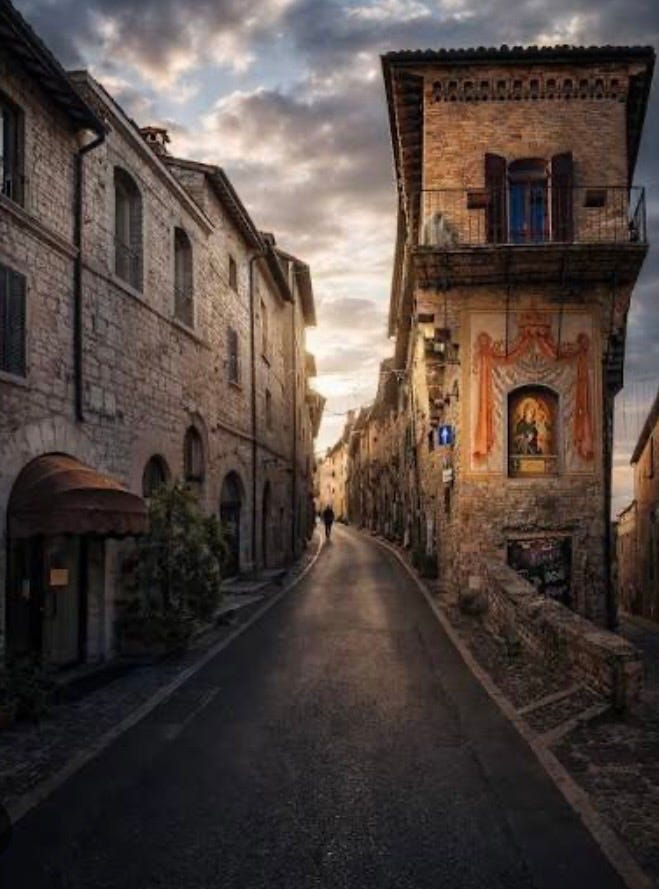
You come to Assisi the wrong way, if you come the usual way. Rome first, with St. Peter’s swallowing you whole, marble in quantities that stop meaning anything. Then Florence and its white perfections under museum skylights. Then Siena, all Gothic stripe and precision. By the time the bus climbs the last of the Umbrian hills, past olive groves giving over to oak and the afternoon falling in long shadows, you have been trained for weeks to look up, at ceilings, at facades, at the achievements of powerful men.
Assisi undoes the training almost at once.
The bus stops at Porta Nuova because it has to: the walls don’t admit it. You go in on foot, and the first thing the city does is put stone under your hand. Pink stone, the famous scaglia rossa, the grey rose rock of Monte Subasio, the mountain the town is quarried from and built into, so that the city looks less constructed than organically exhaled by the hillside. The paving underfoot is worn by eight centuries of foot traffic. The walls rise close on either side, even fitted without mortar in the oldest stretches. I brought people up this street many years in a row, and I watched each of them do the same involuntary thing: stop, and touch the wall. Nobody tells them to. But the stone asks for their hand.
That is the first lesson Assisi teaches, and it is a Good Cities lesson: some places are known through the eyes and some are known through the body, and Assisi is emphatically the second kind. You do not comprehend it as much as you are worked on by it.
I eventually learned to read Francis through this city rather than through the frescoes, and it took me years of returning to Assisi in order to understand the difference.
The basilica will give you Francis as an image. That’s Giotto’s cycle, the saint in twenty eight painted scenes, gold and lapis and biographical narrative. It gives you Francis retrospectively: a life already gathered into meaning, already a saint, already explained. The city outside the basilica gives you something much harder to see, namely the young man before anybody knew what his life would mean, the Francis who was made here, made by these streets, made before anyone thought to paint him.
San Damiano
Go to San Damiano, the small chapel below the walls where the painted crucifix is said to have spoken to him: “go and repair my house, which is falling into ruin.” The story is famous. What the story leaves out is what the place makes obvious: Francis took the words at their most literal and set about mending the chapel himself, begging stones from the townspeople and laying them with his own hands. A merchant’s son, raised soft in fine cloth, meeting for the first time the difficult reality of matter: the weight of a stone, the patience of mortar, the education only the material world can give. The place refuses to let you hold onto a conversion as a purely spiritual event. Whatever was happening in Francis had to pass through the body too. It passed through a lifted stone and a bent back, through the resistance of matter. The saint was built the way the wall was built.
The Piazza
And then there is the piazza, which is where I’d send anyone who wants to understand what I mean by a city teaching or a teaching city.
The Piazza del Comune has at its head the Temple of Minerva, which is six Corinthian columns, Roman, among the best preserved classical temple facades in Italy. But here is the thing that makes it Assisi and not a ruin in a field: it was never left to stand as a monument. It was used, and used hard. In Francis’s own day the commune had taken the old temple for its town hall and its prison. There was the council chamber above, cells below, the classical portico become the face of civic power and civic punishment at once. Giotto painted it that way, barred windows and all, in the basilica up the hill. Only centuries later, in 1539, was it made into the church it is now, Minerva’s columns opening at last onto an altar. Beneath the square, if you go down through the museum, the Roman forum is still there: original pavement, cisterns, inscriptions. A medieval city standing on a Roman one, both still present, the past holding up the present without dictating it.
This is the layering I keep coming back to in these dispatches, and Assisi has it as cleanly as anywhere I know. But the piazza’s deeper lesson is civic and that town hall and prison at its head is the proof of it. This square, around 1200, was a place of faction: the maiores and the minores, the greater and the lesser, the propertied families with a voice in the commune and the tradesmen and laborers pressing to be heard. Cities that build cathedrals also build war towers. The hands that carve altars also raise walls against the neighbors. Assisi tore at itself over who deserved a share, even spilling into open revolt. The young Francis Bernardone, a cloth merchant’s son, well-off and ambitious, once a prisoner of war after the town’s fighting with Perugia, grew up inside that division, inside a split society.
The break came a short walk downhill, in another square. Below the Piazza del Comune lies the Piazza del Vescovado, the bishop’s square, with Santa Maria Maggiore, Assisi’s former cathedral, at its edge and the bishop’s residence beside it. There, in 1206, hauled before Bishop Guido by a father who wanted his squandered money back, Francis handed the inheritance across and then the clothes as well, stripping to nothing in front of the town and giving even his garments back to Pietro di Bernardone. “Until now I have called you father,” he is remembered as saying, “from now on I say only, Our Father who art in heaven.” The bishop covered him with his own cloak. It is worth saying that Francis himself, in his Testament, did not locate his conversion here: he placed it in an encounter with lepers, in the body’s revulsion overcome. The stripping was the public, legal, civic rupture and Assisi gave the drama two squares: the communal piazza that formed the divided young man, and the bishop’s square where he broke, in daylight, with the world that had made him.
I sometimes imagine that square afterward. The crowd thinning, people drifting back to their markets and shops, the pavement staying, Santa Maria Maggiore keeping its corner. Nothing in the walls had changed. But the measure of the place had. What had just been possible in that public space had changed what was possible. That is what a city can do, and what this one did: it held the ground on which a life could turn, and then it went on being an ordinary square, which is the most extraordinary thing about it.
The Carceri
If you have good knees and the morning available to you, walk out through Porta dei Cappuccini and take the road climbing Monte Subasio toward the Carceri, the hermitage in the oak woods above Assisi. It is a steady couple of miles up. You have spent time under Assisi’s narrow sky, seeing a ribbon of blue between three story walls, the buildings so close you could nearly touch both sides at once. Up here the sky opens to a full dome and you remember what it looks like with space to spread. Francis went up to be compressed into himself, the town below gathered him back into the company of others. The whole shape of him is legible in the geography: the mountain above for withdrawal, the city below for the life among people, the road between them walked so many times it wore into him.
That is the argument I keep making, and Assisi is one of the places that taught it to me: a city is not merely the setting of a life. Sometimes it is the instrument of life. Francis did not happen to be born in Assisi. Assisi is part of how he was made, and the town still does its slow work on whoever climbs its streets and puts a hand upon the stone.
The stone will be there when you come.
Pax et Bonum!
C.W. Höjer
I returned to Assisi over several years, learning to read Francis through the city itself. That work is becoming a book: Enchanting Assisi: Walking in the Footsteps of St. Francis (Church / Morehouse Publishing, 2027). Over the coming months I’ll be returning to some of the places that taught me to see Assisi differently: San Damiano and the Carceri, the story of Clare’s city as well as Francis’s city, and the roads that lead between them.