

A dispatch from Ephesus, where the greatest commons of the ancient world stands open to the sky and where a riot in a theatre still teaches how cities live and die.
We came to Ephesus with the children, down the long marble street the ancients called the Arcadian Way, which once ran from the theatre to a harbor that is no longer there. The sea has withdrawn. Silt filled the port over the centuries until the water eventually lay miles from the quays, and the city that lived by it slowly emptied out. Now you walk toward a harbor of grass.
This is the first thing Ephesus teaches, and it teaches it before you have read a single plaque: a city is a living thing, and living things can die. Not by conquest — Ephesus was not sacked into oblivion — but by the quiet failure of the conditions that made it possible. The harbor silted up; the trade moved; the people left. What remains is a complete urban commons of the ancient world, a whole city of public rooms open to the sky, with no one to fill them.
The Rooms Without Roofs
I have written that a city lives in its spaces rather than its buildings: in the thresholds, the streets, the squares, the societal rooms where public and private life meet. Ephesus is that argument made visible, because at Ephesus the private buildings are mostly gone and the public rooms remain. You walk the Curetes Street between the ghosts of shops and see, still standing, the things that belonged to everyone: the great theatre cut into the hillside, the agora, the terraced houses, the Library of Celsus with its facade of marble.
The children ran ahead of us along the marble, as children do, indifferent to the meanings our guidebook had prepared for us. They wanted the cats, of which Ephesus has many, sunning themselves on two-thousand-year-old stone. And there was something very right in that. The commons was never a museum. It was a place where life happened, where a child might chase a cat while his parents argued philosophy or bought fish or shouted in the theatre. The stones do not know they are old.
The Riot in the Theatre
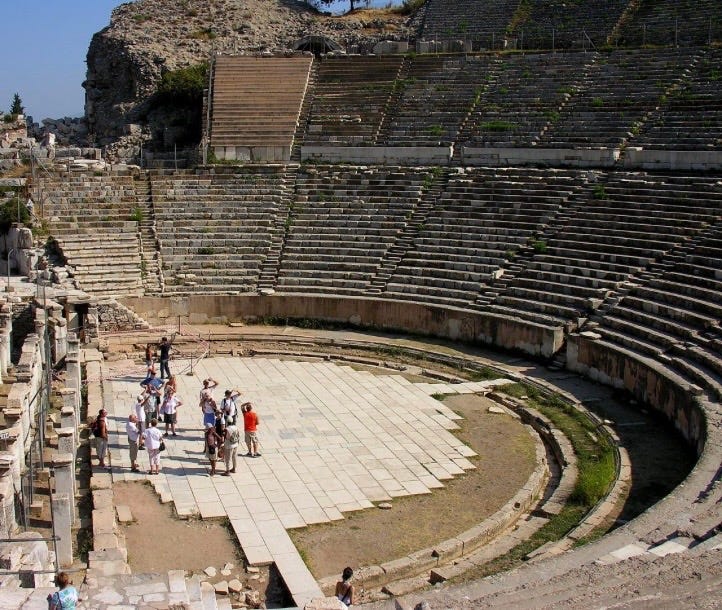
It was into that theatre — the great one, carved into Mount Pion, large enough to hold twenty-four thousand people — that the city poured in a fury one day around the year 55, and the story is told in the nineteenth chapter of Acts.
St. Paul had been preaching in Ephesus, and his preaching had a commercial consequence. A silversmith named Demetrius, who made silver shrines of Artemis, saw his trade threatened, as Paul taught that gods made by human hands are not gods at all. Demetrius gathered his fellow craftsmen and reminded them, plainly and clearly, that their prosperity depended on the goddess. The city filled with confusion and rushed into the theatre, seizing two of Paul’s companions, and for the better part of two hours the crowd roared with one voice: Great is Artemis of the Ephesians! Paul wished to go in and face them. His friends would not let him. In the end the town clerk quieted the mob down with a lawyer’s argument: the courts were open, and they risked being charged with rioting, and the assembly dispersed.
I stood in that theatre with my own children nearby and thought about what the story actually shows. Here was the urban commons doing exactly what a commons does: gathering the whole city into one room to contend over what it loves and what it fears. And here, too, was the oldest sickness of all cities: private greed dressed in the robes of public piety. Demetrius did not say my income is falling. He said the temple of the great goddess will be despised. The coin beneath the creed. It is the same thing we have heard many times before, the Caesar’s-coin logic, the moment when a city’s shared devotion is revealed to be, underneath, a protection of someone’s trade.
The theatre held both things at once: the genuine passion of a people for their goddess, and the silversmith’s ledger. That is what a great societal room does. It brings the whole argument into the light where it can be seen.
The City of St. John and the Virgin
Ephesus is layered, as all long-lived cities are, and the layer that came after Artemis was Christian. On the hill above the ruined city stand the remains of the Basilica of St. John, built over the traditional grave of the evangelist, who by ancient tradition spent his last years here and wrote his Gospel and his letters in this place. Below, the marble street; above, the apostle’s church. The city that rioted for Artemis became a city that guarded the tomb of the man who wrote: “In the beginning was the Word.”
A few miles away, up the wooded slope of the mountain the Turks call Bülbüldağı, the Hill of Nightingales, is the small stone house they call Meryemana — the House of the Virgin Mary, where tradition holds that John brought the mother of Christ to live out her days, as he had been charged to do from the cross. Since it was rediscovered in the last century many pilgrims come to it, Christians and Muslims, to drink from the spring and to tie their written prayers to a wall. We went, with the children, and it was quiet in the way that only places worn by generations of prayers are quiet.
On the way up the mountain to Mary’s house we passed the Cave of the Seven Sleepers on the northern slopes — seven young Christians who hid from persecution, fell asleep, and woke generations later to find the empire itself had become Christian. It’s a story about time, and waking, and how long a city’s memory can sleep before it stirs again.
What Ephesus Leaves Us
We looked out over the empty harbor as the light lengthened, the children tired now, carried and cajoled. A great city had stood here for a thousand years and more. It had a theatre that held twenty-four thousand, a library, an agora, temples that were counted among the wonders of the world. And it died. Not violently, but by the withdrawal of the sea and the slow departure of the people, until nothing was left but the commons itself, the public rooms standing open under the Aegean sky.
This is the lesson that answers the one I have been writing about cities that die: that the commons is the last thing to go, and the first thing to be read. When the private houses have fallen and the harbor has vanished and the people are two thousand years gone, what remains is the shape of how they gathered: the theatre where they roared, the street where they walked, the agora where they met. A city’s soul is legible in its public spaces long after everything else has failed.
Maybe our children will remember Ephesus. Or maybe they are too young. But they ran its marble street and chased its cats and stood, without knowing it, in the theatre where a city once shouted for two hours over the difference between a god and a silversmith’s trade. The stones held them for an afternoon, as they have held so many, and will hold many more, and know nothing of any of us.
Pax et Bonum!
C. W. Höjer
Next: we return from the ruined agora to the living one — what Socrates saw in the public square, and how a fresco in Siena still shows the difference between good government and bad.