

Part 3 of a series on good and bad government in place and time
As a tourist our plane or train ticket may say that Rome, Italy, is our destination, but it may quickly occur to us that as we step out of our taxi we’ve arrived in Parioli instead. Parioli is a neighborhood that was developed in the nineteenth century as an autonomous community for the new bureaucrats of a unified Italy. It lies in the heart of Rome, on the far side of Villa Borghese, but is a rather unpretentious residential area in comparison to the monumental buildings of the centro storico, “the historical center.”
On the other side of the Tiber River we can be charmed, even mesmerized, by Trastevere, which was the ancient neighborhood of plebeians and foreigners. It was here that Saints Peter and Paul preached the gospel, making it the original place of Christian conversion and conversation. You may also travel outside the walls of Rome to a rather uninteresting neighborhood called Garbatella, which wasn’t incorporated into the city until Mussolini’s fascist regime.
The Mystery of Urban Experience
In other words, the western tourist can spend days and weeks in Rome without being introduced to the majority of the urban environments which constitute modern Rome. One can also visit Rome for a day and be guided to everything Roman in atmosphere and sense experience from the taste of Spaghetti Alfredo to the incense at St. Peter’s Church and the wonder of The Roman Forum.
Likewise, one can pore over every detail on the syllabus, use every minute to the study of theology and politics, to the developing visions of Roman empire, lend one’s ear to the music of Palestrina, train one’s eyes to the architecture of Bernini, walk with one’s nose inside a book for weeks on end, and still not form a relationship with Rome as a living society.
A disappointing and unduly expensive espresso in the Piazza Navona, or a successful dinner on a mistaken outing to the wrong neighborhood, can make or break one’s experience of the city. How could it be otherwise, when men and women were created for love and life and not for facts?
The City as Organism
Every cosmos, every urban society, is an organic construction built by people and for people, but it’s also a living organism in and of itself. The matter of our cities is composed of wood and stone, steel and glass, cement and marble. Its shape and design is constituted by families and individuals, social classes and worker’s guilds, craftsmen and builders, while the end or purpose of our cities is informed by religion and politics, poetry and architecture, fashions and values.
This means that our cities are as interesting and intriguing as the people who inhabit them, requiring an equal amount of caution and receptivity to gain their trust, the same amount of psychological tact and social creativity, a similar cultivation of dialogue, in order to form a lasting friendship. This is why one can fall in love with a city, as one can fall in love with a person.
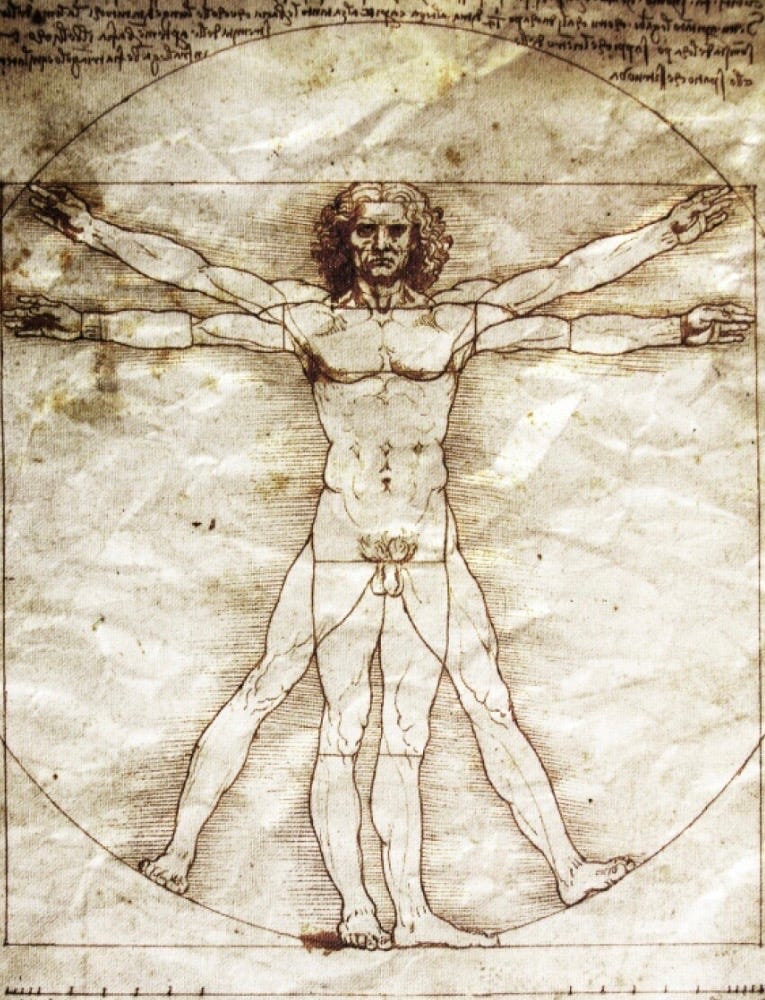
It was therefore no idle dream when Leonardo da Vinci presented his Vitruvian Man as the ideal for architectural proportions and man’s body as an analogy, in microcosm, for the workings of the universal cosmos.
Istanbul: The City That Contains Everything
A global metropolis often contrasted with The Eternal City of Rome is Istanbul, sometimes known by its classical name, Constantinople. Istanbul is a world capital if not a national capital, on the edge of western civilization and it’s the largest European city by population.
It’s been said that migrating Turkish horsemen in the eleventh century stopped some Greek farmers in the fields of Anatolia to ask them what they saw on the horizon and where they were heading. The farmers looked up from their labor and answered them, “eis Tçn Polin,” you’re heading “to The City,” hence the development of the name Istanbul. Like its imperial counterpart in the west, which was simply known as “Urbs,” Constantinople was simply known as “Polis.”
Istanbul can be an informative example of how a city resembles the people that inhabit it and how to interpret her social and historical cues. For example, after several days of sightseeing around the Bosporus one can gain the uncomfortable feeling of having admired every major sight, except for Istanbul. Istanbul is a myriad of impressions containing all of western civilization. Arguably it has everything, but it can also be argued that that’s all it has.
Not all cities are created equal for not all cities are the sum of its parts—some cities are greater than its parts, while some cities are less. As we search for the heart of Istanbul, an Istanbulian spirit, we’re calculating our experience according to this measure.
The Search for Istanbul
Visiting the “New Rome,” we’ve been spellbound by Hagia Sophia and admired the Blue Mosque. We’ve visited the underground chambers of ancient Constantinople, we’ve wandered through the hallways of the Topkapi Palace to gaze at The Spoonmaker’s Diamond, and we’ve crossed into the Besiktas neighborhood to visit the Dolmabahçe Palace, home of the last Caliph and the first residence of Atatürk.
We’ve been mesmerized by the Spice Bazaar in the Eminönü neighborhood and played the western intellectual at the Pier Loti cafe overlooking the Golden Horn. We’ve even visited The Patriarchal Cathedral of St. George, seat of the Ecumenical Patriarch, to think about religious unity and division. We’ve found our favorite coffee bar on Algerian Street, behind the Galatasaray High School, which after a few days of tourism we can almost find without directions.
We’ve even walked to the Galata Tower, where we climbed its staircase to enjoy the panorama over Istanbul from its observation deck. It was originally built by emperor Justinian, but was later rebuilt for the Genoese colony as the Holy Cross Tower, before the Muslim Ottomans claimed it as their own after the fall of Constantinople in 1453.
And yet, with The City at our feet, we feel the need to ask ourselves: where is Istanbul?
The Field and the Garden
Istanbul contains all these things and the things beyond them, but it’s also none of these things too, and it’s also more than the things we see, for it contains multitudes. Precisely in the recognition that a great city has so many parts to it, lies the realization that it would still be itself without a great deal of them. Istanbul would still be Istanbul without the Hagia Sophia, but not without that urban tradition which could beget something like the Hagia Sophia.
This parental relationship is exemplified by an old French adage: Dans l’art comme dans la nature, on est toujours fils de quelqu’un,” which translates, “in art as in nature, we are always someone’s child.”
Istanbul is not the Pier Loti cafe, but the Pier Loti cafe is very typical for Istanbul. We sit with a Turkish coffee at a round table on which we placed a copy of his book Aziyadé, overlooking the Golden Horn, with a commanding view over the European as well as the Asian banks of the Bosporus. Several historical neighborhoods lie under our feet. It’s as if we were sitting inside an aerial postcard, yet we don’t have the impression that it resembles what we’ve experienced down on the streets among its people and buildings.
We know we’re in Istanbul, yet we sit and stare at Istanbul as if we were in another time and place. Later, when we rise from our table to wander down into the city again, we’re not stepping into that panoramic postcard. Instead, as we return to Istanbul, we return to the bustling energy of the city, and as we return we notice how Istanbul disappears into its component parts again.
The imminent experience is a very existential one, which may be compared to a field of soil where you wish to build a beautiful garden, of which the Muslim world has so many. As soon as our garden is completed, our field has disappeared. We know the field is still there because our garden grows upon it, but in this field there is no longer any field to be seen, but a garden.
Istanbul’s Dynamic Personality
By such imaginative ways we begin to understand the urban history of Istanbul. We start to comprehend that even if the city is ancient, Istanbul is a modern city. Its history from Roman capital to Catholic empire, from Christian bulwark to Muslim caliphate, from Ottoman stronghold to Turkish Republic, is a story of developing modernity.
It becomes quite clear that Istanbul has a dynamic personality, which consists in constantly reinventing itself by displacing its own past. It’s by studying its broken trajectories along streets which speak of ideological and religious conflicts, political renewal and social revolutions, that we see how Istanbul nevertheless has become Istanbul.
The city has grown through such diverse and violent eras, from the eastern capital of the Roman Empire, of which there are so many memories around the Hagia Sophia, to Atatürk’s muslim democracy in the Twentieth century, that we must utilize reading glasses with an “archaeological prescription” in order to catch sight of Istanbul in all of Istanbul.
Tourists are not prepared for this, for in contrast to Rome Istanbul doesn’t notify us when we walk from one historical era to the next, as we climb up and down its layered history. It rather seems to tell us an opposite narrative, that a haphazard history has at different moments sprinkled its cultural parsley over Istanbul’s bountiful, divergent, smorgasbord.
The Grand Bazaar as Political Philosophy
This is what confuses us, since it doesn’t lack definitive personality traits, quite the opposite. Eventually we come to recognize that its typical characteristic is a strong desire to show the world that Istanbul can survive everything and everyone, that it can master the cultural balancing act between Asia and Europe.
In the middle of the sixteenth century, in the era of classical Ottoman architecture, Süleyman the Magnificent, challenging both his namesake and referencing Emperor Justinian, is supposed to have boasted: “Solomon, I have surpassed thee!” Nowhere in Turkey is this saying more evident than in Istanbul.
From an empire to a republic, the historical pattern has remained unchanged: Istanbul is more than a city, but it’s a city through being Istanbul, which is to say that it’s a grand bazaar showcasing power, riches and influence. It’s the personification of The Sublime Porte, as Istanbul was once known in diplomatic circles. In its patterns of architecture and summarizing language, the contours of Istanbul’s urban design draw a political silhouette.
It’s striking how the hills of Istanbul have been covered with streets and squares which are meant to express the magnificence of the Ottoman-Turkish empire. We can delight our eyes by admiring Mimar Sinan’s architecture, who designed the Süleymaniye Mosque complex, where we can experience his dynamic designs. He has been compared to Michelangelo, his contemporary in the West, who was building the St. Peter’s Basilica in Rome at the same time.
Two Approaches to Urban Unity
With this in mind, one can’t say that the modern socialist and fascist-inspired Istanbul University or the contemporary Nordic-inspired Istanbul airport are in any way out of place. They’re by point of fact prominent examples of the same manner of assimilation which has always been so dominant throughout Istanbul’s urban history.
It’s at times rather moving—one might say paradoxically—that although the Ottoman Empire is a distant memory, the city still speaks with the same grand Caesarian language, forever under the gaze of Emperor Justinian and Süleyman the Magnificent. This helps to explain why the interlaying neighborhoods, with all their eastern Mediterranean flare, are experienced as idyllic and quaint, happily untouched, as they circle under the wing of these buildings. It’s here, between the tulip-shaped tea cups and endless games of backgammon, that the local Istanbullu live and feel at home, where we can see how a disjointed evolution is typical for Istanbul, while a development of unity is typical for Rome.
What This Reveals About Good Cities
Rome and Istanbul teach us something crucial about urban organisms. Rome has achieved unity through continuity—layer upon layer of development that somehow speaks the same language, from ancient columns to Baroque churches to modern neighborhoods. Even when it changes, Rome remains recognizably Rome.
Istanbul achieves its identity through constant reinvention—by demonstrating that it can absorb and survive anything, by making a virtue of its capacity to be many things at once. Istanbul is Istanbul precisely because it refuses to be any one thing definitively.
Neither approach is inherently superior. But they reveal two fundamentally different philosophies of urban life: one that sees the city as an inheritance to be preserved and extended, another that sees the city as a stage for perpetual transformation and display of power.
The question for every city is: which model serves human flourishing better? Which creates spaces where people can actually live, work, worship, and form communities? Which respects the principle of subsidiarity, allowing neighborhoods to maintain their character while contributing to a coherent whole?
Pax et Bonum!
C.W. Höjer
Next: The Geometry of the City—how urban patterns shape human experience, from the grid to the organic labyrinth.