

Part 1 of a 3-part series on the origins and nature of urban life
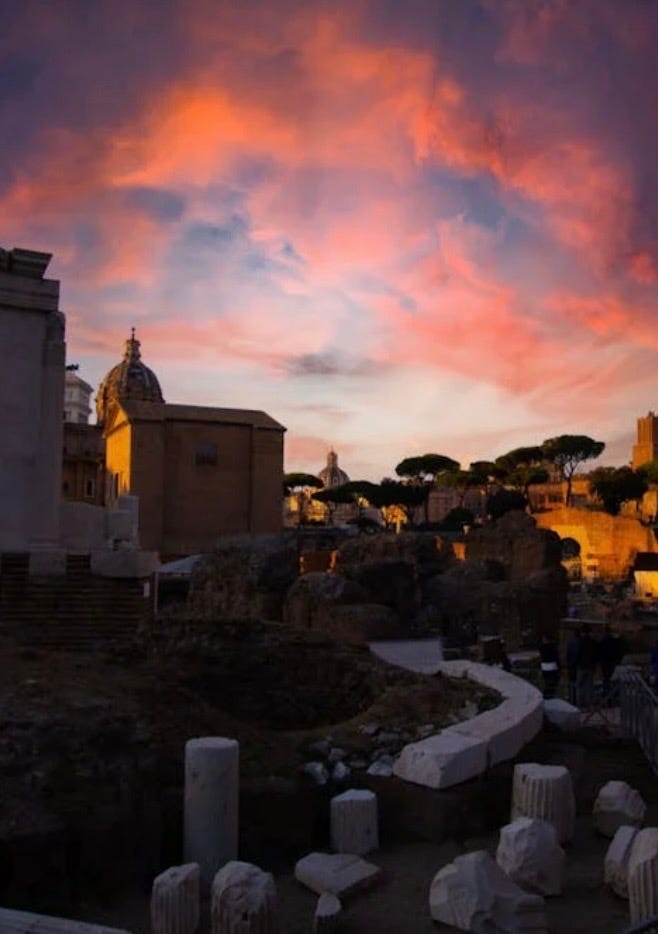
Architects and sociologists tend to differentiate between planned urban centers and original urban centers—between cities which grow according to a set agenda and cities which spring up naturally out of human necessity, especially along waterways and coastlines. Still, many cities have an origin story which is a combination of these two forms of urban procreation.
Rome itself, the crown of pagan citizenship, the city of cities, is probably one of these hybrid types. It was founded far back in antiquity by the Trojan-blooded Romulus on April 21st, 753 BC, but precisely over and above an earlier trading post in the Tiber River valley. This location already possessed enough geographical strength to have become a crucial meeting point between the Etruscan, Sabine, Oscan and Latin peoples. The Romans transformed this early trading post into a marble phenomenon over a gridded, domed and rectangular-shaped urban landscape.
After the Roman “One Thousand Years” and the sack of Rome by Alaric and his Goths and Visigoths, it was slowly rebuilt by the papal court during the Middle Ages and the Renaissance. Yet Rome can aptly be called a Baroque city due to its architectural transformation during the Counter-reformation during the sixteenth and seventeenth centuries. Modern architects have contented themselves with formalizing individual areas and neighborhoods, which time and space had already made into small towns within the larger city.
Before the Eureka Moment
But before the architectural genius of Michelangelo and Bernini, even before Vitruvius, there was the city as an archetype for the social and political animal we call mankind. There seems to have existed certain preconditions and certain needs within our human nature which developed into villages, towns and cities.
There is no deductive reasoning which leads us to assume that a farmer, such as the biblical Cain, woke up one morning, washed his face and wondered if he ought to build the city of Nod that day. Urban history doesn’t begin with a Eureka-moment in the bathtub, but rather through a development, a slow organization of our environment. Most likely, the human organism required an urban organization.
Historians are similarly left speechless if asked when and why we began to cut our hair or sew our clothes. Recognizing the usefulness of rising heat, the Roman bathhouses used underground fireplaces to heat their pools and walls, so it’s a mystery why they didn’t simultaneously invent the steam engine. We can only guess at the instrumental achievements mankind could have acquired, maybe offsetting the whole trajectory of The Industrial Revolution sixteen hundred years before James Watt. Perhaps lacking the Christian convictions against the crime of slavery allowed the Romans to overlook the necessity of machine-power, despite their scientific knowledge. Still, the mystery remains.
The First Cities
Returning to that ancient brotherhood of Cain and Abel, we must ask what makes an agricultural people, formed out of a nomadic culture of sheep herders, to found a city. A tent is different from a house. Man cannot carry a house on his back, a city cannot be transported from the Hellespont to the English Channel, as if Brutus of Troy could have moved the temples of Illium to Britain when he founded England, Scotland and Wales.
No, a city must be where it’s founded, until it’s either burned to the ground or leveled by war or plague. If it’s abandoned due to political turmoil or environmental disaster, a city will slowly be overgrown with weeds and flowers until nature decides to hide it from history. Under layers of mulch and ash such ruins slowly sink into a collective forgetfulness until archeologists of the modern age uncover them again.
It wasn’t until Pompeii was uncovered under Mt. Vesuvius in the 18th Century by Karl Weber that archeology was born. By that time nearly eighteen-hundred years had passed since that city was covered with volcanic ash and overgrown with weeds and flowers, but the excavations told us something important about urbanity: as a citizen is much more than his home address, a city is much more than its design. It’s not merely a shelter from the storm, but in its genesis strives to be an architectural solution for perennial social problems.
The Political Animal
The ancient Greek philosopher Aristotle defined mankind as a political animal, and every city, every polis, has as its foundation the organization of our human lives. Our cities depend upon an original balance of private interests and public deliberations, which then inevitably assimilate foreign elements into their urban cosmos either through their seaports or airports. These foreign elements may be new gods or new people, new foods or new philosophies, either because the city thrives through such commerce or because it is occupied by a foreign power.
If cities weren’t a natural place for us to preserve our accumulated traditions and knowledge, we wouldn’t know our history very well, nor would there be such a wealth of knowledge to acquire through a system of education.
The veins and arteries which vivify the urban body are not invented by political decree or a gathering of sociologists and master builders. Rather, it’s something that grows and develops out of natural necessity and specific cultural conditions into a social map, a recognizable pattern, of human interaction.
Next post: From Jericho to the Nation-State—how cities laid the foundations for modern political order.
This is a FASCINATING three part series, Wilhelm. Beautiful, thoughtful, artistic and well-researched is an understatement.
Where are you sending this? I need to print it out and I will!!
Amazing!!