

Part 1 of a new series on good and bad government in place and time
Not all cities are created equal. When we consider the theatre of life which is performed before our eyes in every city, we see a master play containing many parts, if not every part of life, which is dependent upon a dramatic organization, on the proper roles of its characters, who support one-another as in a well-written script.
This is something we rarely think about. Yet urban histories have developed on the world stage for all to see, in a causal relationship and with an inner logic, which has driven their plot lines with an almost natural determinism. Different cities have told different stories. Some cities have told a story which is better at presenting human reality, while some have prevented us from seeing this same reality. The different forms of urban life arise from a deep relationship between imitation, reason and innovation.
The City as Movement
The urban reality is not simply a place, it is also a human movement towards something and away from something, because if we tell the world what we’re for, then we automatically tell the world what we’re against as well. The human drama is always unfolding towards some end in every city. It has a motive and the motion of human bodies is oriented towards the original commission of mankind, which is the original fulfillment of man’s end—that is, our ultimate values.
In other words, our lawgivers are dramatists and our virtues are reasoned decisions in an unfolding public spectacle. The craft of civic leadership is to rule by our values, making politics a moral dilemma, for any political regime which isn’t leading man to his ultimate end and facilitating that movement is not to be left alone.
The Question of Virtue and Greed
In his book on politics, De Regimine Principum, St. Thomas Aquinas argues that we are raised by our families in order to become virtuous citizens who seek to work with other virtuous citizens to create a very particular type of city: an altruistic society which Jesus names The Kingdom of God. Since the art of politics traditionally falls under the category of moral philosophy, the aim of legislation is the defense of virtue which entails protecting common goods and promoting the public good.
Yet St. Thomas asks the reader to consider what will happen to our cities if common virtue is not the fulfillment of politics—what if it is private greed?
The Sign of the Coin
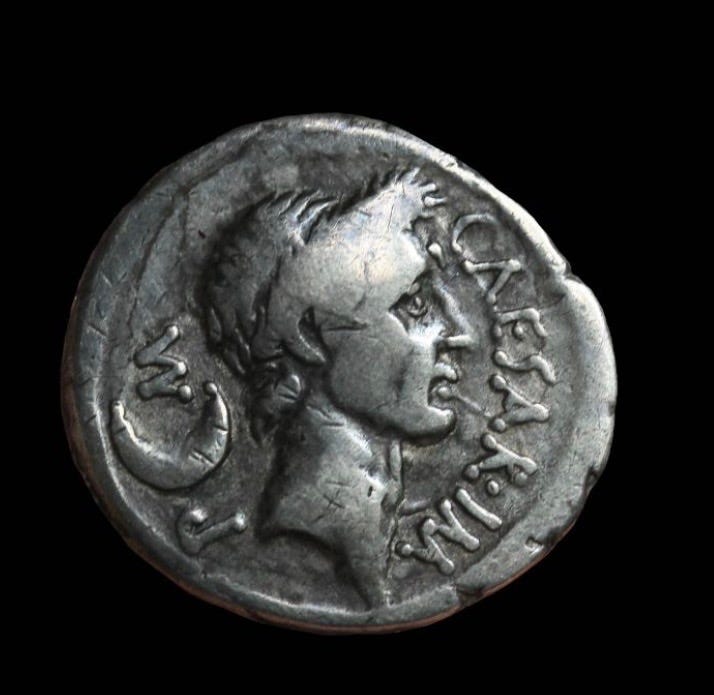
The sign and symbol of cities motivated by private greed, instead of common virtue, is the coin, which is why the quintessential political story is Jesus’ comments about Caesar’s Roman coin. It’s a story which we find in the Gospels of Matthew, Mark and Luke.
In all of these accounts the Pharisees question Jesus in order to trick him, that he might convict himself of a civic crime. The question involves whether it is right for Jews to pay the taxes demanded by Caesar. At first, Christ asks his interrogators for a Roman coin, since he never carries money himself. The coin which he holds up for the crowd to see has the image of Caesar Tiberius emblazoned on it with the inscription, “Son of The Divine Augustus.”
When Christ replies to the Pharisees that man should “render onto God what is God’s and unto Caesar what is Caesar’s,” it tends to lead some modern commentators to interpret this as a bifurcation between virtue and politics. But we might ask what precisely is not the property of God? For as the story progresses, Jesus says that what we owe God as citizens is our love with all our heart, mind, soul and strength.
In other words, the divine law is meant to be an invitation for mankind to fulfill his human anthropology. The traditional interpretation of this story is that the Roman coin is shown to be an idol. Therefore, the only thing which we can render unto Caesar is our idolatry, and not our civic virtue, which is meant to be directed toward the common and public good.
The Prophetic Warning About Globalization
In a prophetic description of our globalized world, St. Thomas, quoting Aristotle, writes that if every city is driven by greed, then all people will soon live in one city. In ancient Athens, Aristotle had said that if commerce and trade with other cities is the ultimate end of our urban lives, then international trading laws will need to be formulated which override any national laws on trade, facilitating commerce and private profit.
Coins will need to be minted that are universally accepted. Since capital is designed to unify two parties within a trade agreement, then difference and culture will need to be sacrificed or replaced by uniformity. Customs and rules tend to be diverse from one culture to the next, which builds obstacles to free trade and inhibits the formation of an international financial class.
It’s easy to see that if prices vary according to custom and culture, then trade or exchange cannot be done from abroad but must be done in this or that particular market square, in accordance with the laws of each city. Globalization must therefore carry in its wake the destruction of every dialect, local custom and regionalism, over upon which is constructed a uniformity of aesthetics and philosophical outlook.
Western philosophers, such as Aristotle and St. Thomas Aquinas, staunchly defend local civic life, by praising the varying forms of urban cultures as opposed to the uniformity of networks.
The Stakes of Urban Design
This opening reflection reveals what’s at stake in how we build and govern our cities. Are they stages for virtue or monuments to greed? Do they cultivate local particularity or global uniformity? Do they facilitate human flourishing toward our proper end, or do they reduce us to economic units in a vast commercial network?
These are not abstract philosophical questions. They manifest in concrete form every day in the choices our cities make: what they build, how they zone, what they permit, what they celebrate, what they preserve, what they demolish. Every street corner, every public square, every neighborhood tells us what the city values—and therefore what it believes human beings are for.
In the posts that follow, we’ll explore how cities embody these competing visions through their actual forms and structures, from the nested communities within great metropolises to the geometric patterns that shape our streets.
Pax et Bonum!
C.W.Höjer
(Next: Cities Within Cities—how great metropolises contain multitudes, and what that reveals about urban life.)