

Back in 2020, by the old downtown, known colloquially as the “silk stocking district,” my family moved to Fernandina Beach, which is on an island outside of Jacksonville. This once Spanish outpost “is easy to reach but hard to forget,” as the locals say, with beaches running for thirteen miles around scattered parks and historic neighborhoods. Most evenings you would find us on Centre street at sunset, sitting by the waterway between the states of Georgia and Florida, looking out upon a symphony in red from a black iron tabletop. We would sit and talk of many things, of our travels, of the nature of the villages and cities we have visited, our Western Civilization and, generally, how we arrived here in the first place.
One day, eager to discover our new home, we took a drive down 14th street to Old Town Fernandina, on Amelia Island, off the coast of northeast Florida in front of the wide Atlantic. Under oak trees draped in Spanish Moss and green flowerbeds we drove above the marshlands to a flat plateau between two boat harbors. We stepped out of our van into an aroma of sea salt and seaweed. At the same time we also entered the Plaza San Carlos.
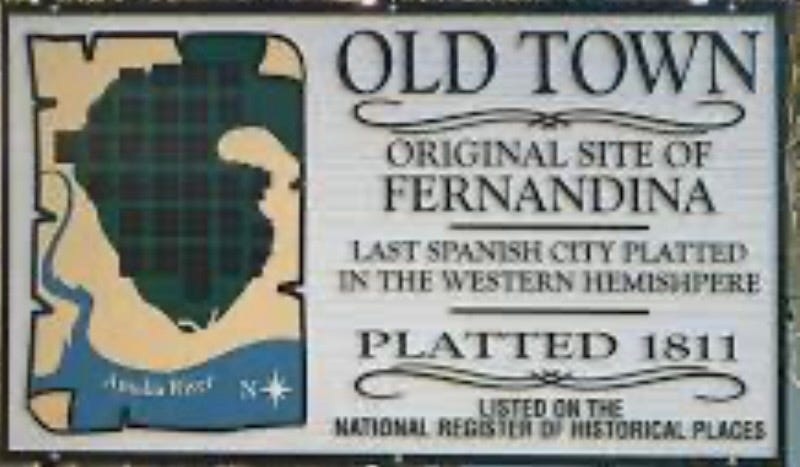
This is the grand name of a square that today is not much more than a bordered lawn and arguably the smallest state park in America. The shops were long gone, so we rolled out a blanket as we prepared a picnic and poured something refreshing into a mug. We sipped on coffee but locals suggested we taste an orange from one of their homegrown trees. The first orange tree in the New World was planted by Ponce de Leon somewhere along the coast just south of where we’re sitting. Other people offered a homemade tea from Yaupon Holly leaves and that we try a magenta- colored berry from a native shrub. The ocean breeze lent its taste a long time ago to these oranges, the beauty-berries and the holly-leaves which were already cultivated by the native Indians tribes between these groves. We sat meditating on the cups in our hands, as examples of a cultural product formed to carry a natural product. We were sitting in a town, on an island, in a sea. We clutched our cups, turning our heads to the left and to the right.
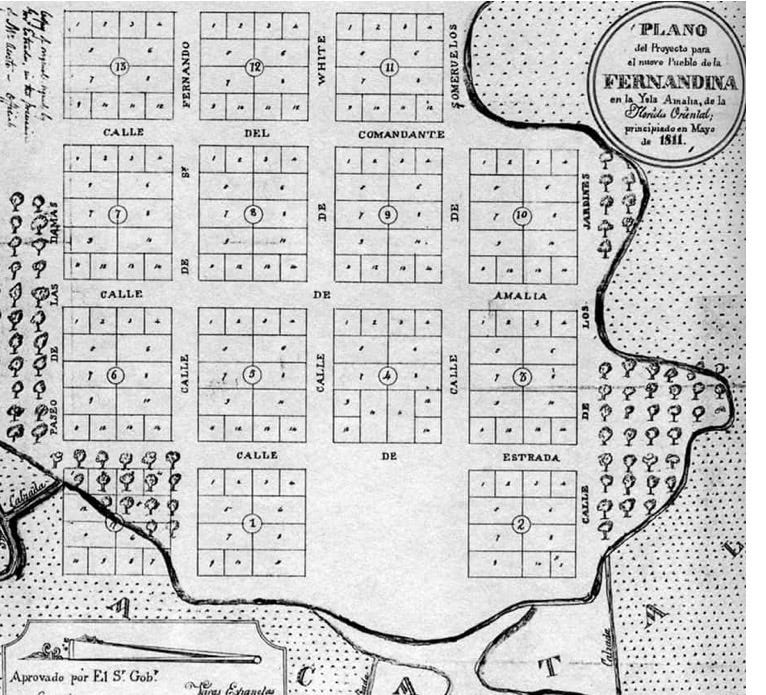
Somewhere to the left, on a street running west to east, there used to be a Catholic church, somewhere to the right there used to be the City Hall. Immediately in front of us there used to be the Fort San Carlos. Today we see the natural deep sea harbor of The Amelia River, dividing Georgia from Florida, and a great expanse of sky around the shorelines. But behind us we can imagine little alleyways between the grid-designed streets which were platted according to the Spanish Laws of the Indies, which hugged the small housing blocks called “peonias.” They were probably built from oakwood and coquina, a coastal concrete composed of lime from burned oyster shells mixed with sand, water, ash, and other shells. We’ve never been here before, but we can recognize everything. In our mind’s eye we see people entering and crossing the plaza, we see a few elegant ladies, some ruffians, the pompous gate of important men and a couple of young lovers scurrying behind our heads. They appear and disappear in the busy chase of life. Suddenly a bell chimes forth some ancient melody from a public tower.
We’re on a naturally beautiful island, but also in the last Spanish city to be platted in the Western Hemisphere, by Enrique White in 1811. It still clutches to its primitive geography, grasping in its identity both to the present and to the past, resisting too much development, preferring to continue to live in a comfortable reach between a Spanish outpost and a fashionable neighborhood. It’s also one of America’s smallest towns.
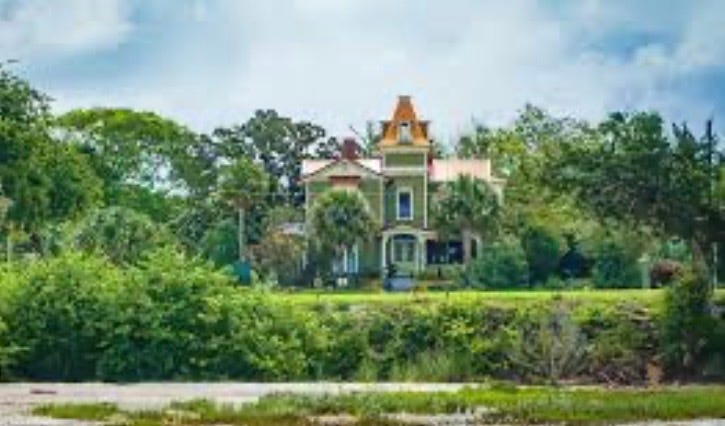
In its concentrated format Old Town Fernandina is an example of all which is typical for how we live our lives, balancing cultural identities with natural conditions. It’s typical for Western Culture that all its essential elements of life can, for example, be detected in the small city plan of Old Town Fernandina. It has its historical origins in a very specific geographical and cultural region, the Mediterranean. Expanding through the Spanish Empire, it became normative for the development of our civilization, which is best witnessed within an urban lifestyle. As an island town in the Atlantic Ocean, Old Town Fernandina has been both centrally and remotely situated during its history. It has lived under eight different flags, can still be read as a geopolitical novel from Queen Catherine de Medici to President James Monroe. It has taken as good care of its cultural inheritance as its natural conditions would allow. It has kept its charm without becoming a tourist attraction. While through its proximity to Fernandina Beach it has opened itself to the modern world without jettisoning its unique personality. In summary, this means that we can sit in the middle of Plaza San Carlos for an hour or so and discover how our civilization came to be and what we’re meant to preserve for the future.
In almost every European language the word for town has an origin that speaks of something vitally essential. The first flag which flew over this area was French. When the French Huguenot Jean Ribault landed on this island on the 3rd of May 1562, he came in hopes to claim the area for France and to found a Protestant village, which is derived from the French word ville which is in turn derived from the Latin word villa, which signifies “a property or a house.” He named present-day Amelia Island the Isle de Mai, “May Island,” and what is now the St. Mary’s River, dividing Florida and Georgia, he named Le Seine. Spanish forces in 1565, led by Pedro Menendez, drove the French from their ville, in order to found “Isla de Santa Maria” with a Catholic mission and a little settlement called a pueblo, which is derived from the Latin word for “a people,” populus, who need a dwelling place. It would then develop into a ciudad, which is derived from the Latin word civis, which means “a citizen,” which has an etymology which we recognize in the English words civil, civilization and city.
The British arrived in the eighteenth century in order to found an Anglican town on their new Island of Egmont, which like ton in Washington is derived from the Dutch/Germanic tuin which means “a bordered lawn.” Other towns of the British colonies which share names such as Winchester, Manchester or Rochester are derived from the Latin word castra, which means “a fortress.” This word - fortress - is in turn derived from the Latin word fortis and the French word fortresse meaning “a strong place,” as in Amelia Island’s Fort Clinch. Ever since Spain negotiated Florida to the United States, this fortress has flown under the American flag.
One doesn’t have to know much about etymology to realize that our words surrounding urban culture were born from a very natural human need and desire. One doesn’t have to leave our picnic blanket at Plaza San Carlos either. It was here that the main Catholic mission of the island was set up which consisted of a little missionary pueblo made up of Franciscans and Indians. It was later during the second Spanish government of Florida that the ciudad of Fernandina was established, according to the Laws of the Indies, set forth in detail on every facet of creating a community, which included a town-plan centered on the Plaza Mayor, which was the organizing urban element. First, a church building was established, then the site for the Royal House house and the Town Hall - all of them around the main square.
To center the life of a village around a church building has been so important for the self understanding of western civilization in the Old and the New World, that the Roman Catholic Church doesn’t take its name from a nation or a prophet, but from a city. The Roman Catholic Church, which is a universal church, calls itself Roman Catholic because it has its political origins in a city which was already the center of the world when the Church overtook it. When the pope steps out onto the central balcony of St.Peter’s basilica to bless his congregation on Easter Sunday, it’s understood that he is speaking to the city and to the world, Urbi et Orbi, as the blessing is called in Latin. The phrase harkens back to the age of the emperors when Rome was simply called Urbs, “The City,” with a very clear implication for the rest of the empirical cities.
When we look around the Plaza San Carlos we can quickly deduce that Fernandina is neither a center of world power, nor a completely peripheral settlement. By the still existent Spanish street names within this American community, we understand that it’s been a town for at least a couple of centuries. By the size of the plateau and this little grassy knoll, which was once the main square, we understand that it was a little outpost of the proud Spanish empire. The view towards the ocean and the sky tells us that nature has never lost its hold upon this island, even if tourism in the form of buses and cars tells you that we are in a modern town. Many of the tourists who are visiting Fernandina alongside us are dressed in clothes from fashionable boutiques downtown. We’re reminded that the island also houses the Ritz-Carlton and the Omni Resort. But the residents of Fernandina do not share this space in order to share in this fame. They don’t trim their bushes and paint their houses to impress the tourists either. They do it out of love for their urban environment, out of respect for their living area, and out of an understanding for their Old Town identity.
Urban culture, however small or large, is part of our human nature. And if we wish to preserve its naturalness, it must be nurtured according to some set rules, not dissimilar to how a gardener tends to the flower-gardens surrounding our picnic spot. This is why the Spanish promoted their Laws of the Indies to the New World. In other words, we’re sitting on a blanket in the Plaza San Carlos, contemplating our cups. We’re sitting on an island within a Maritime Forest filled with Live Oaks, Southern Magnolias, and Sabal Palms, shading understory such as Red Bay, Beautyberry and Yaupon holly. While residents and visitors enter and exit this spot of land, we see that they have always had something natural to do between the houses, which is why the streets were platted the way they were.
We see the gallery’s where sea captains must have watched for ships coming into port, we see that fishermen must have caught fish in the sea, we see that they must have fetched fresh water from wells. We see that they met on this bluff, on this square, in front of this waterway, and talked with each other and sold their goods. We see that people built houses to live in and streets to walk on, we see that they built private enclosures and public meeting spaces, that they raised churches and opened saloons. We see that every nook and cranny had a societal ritual which Old Town Fernandina was designed to accommodate. We already know that these rituals continue in the new town of Fernandina Beach, where a steady stream of visitors and residents walk in and out of buildings, shops and establishments. We see that an urban space is a place where a human life can change both direction and trajectory on a simple errand between the farmer’s market and the clothing store…
Pax et Bonum!
Wilhelm Höjer
This is a beautiful story and should be published on one of the local Fernandina newspapers! It might need to be trimmed a bit for publication but it is SO interesting and descriptive and filled with history, mystery and woven designs of past and present!!