

Urbis et Orbis
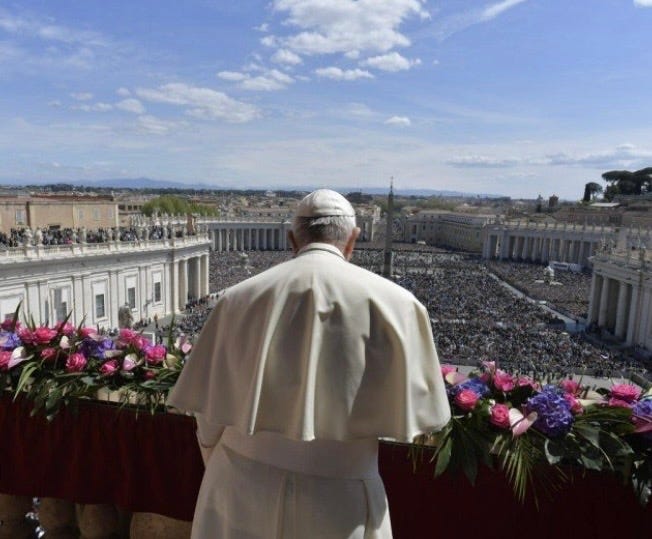
Centuries ago Edward Gibbons wrote his Magnus Opus about the Rise and Fall of the Roman Empire, which was both a city and a world empire, for both questions are equally fascinating. That a city arose from human endeavor is just as mystical as how it fell. Often people will ask what happened to the sunken Atlantis, but fewer people will ask how Atlantis arose. As European men and women set foot in the New World as they sailed beyond and above the mythical Atlantis, they began cultivating the land and building villages, just as in the Old World. They built the new world with what might be called practical nostalgia. Nostalgia is a compound of the ancient Greek words nostos (homecoming) and algia (longing).
I’m a European and I’m an American. Europe and America are often identified with their cities. New York, Chicago and New Orleans have all woven themselves into our cultural fabric as much as London, Madrid and Copenhagen. On the one hand, we love our cities, we love to travel to cities and identify with our cities. On the other hand, we also love the long expanse of the country-side, the farmhouse and the country estate. In the modern world this conflict between city and country-side is as old as landed gentry and urban industrialists. Yet the conflict is also as ancient as Cain and Abel. Therefore it’s natural within Western Civilization to speak about urban life, because the question of urban development has always been pertinent.
The origin and organization of city-life are not necessarily of Western invention, but European and American influence upon human civilization is so deep and wide that their cultural characteristics are unavoidable when thinking about how we live our common lives. But the Western manifestation of urbanization is not merely historically contingent, it has a specific historical trajectory from Athens via Rome to New York City, while at the same time being capable of assimilating and adapting itself to different cultures. In other words, urbanity is relative, but not relativistic.
This Substack will describe the good and bad government of our cities. It is meant to be a reflection about the urban and rural life of America and Europe.
I’ll begin on a little Floridian island, where I’ve spent some time, where European man settled a Catholic mission under the aegis of the Spanish crown. At the same time I’ll supply some handy tools through which to interpret our metropolitan lives.
Villages, towns and cities help to define who we are and our Western roots play a central role in our urban and rural understanding. It’s a foundational aspect of the civilization in which we live. Naturally, there are many reasons to explore a certain spot on planet earth and to delve into the essence of our civilization, but it’s finally about a deep seated desire to feel at home in the world.
Personally, I’ve always lived in world capitals such as Washington DC, Stockholm and Rome. This Substack is inspired by the innumerable days in which I have walked the streets of American and European cities and attempted to engage in a direct conversation with the urban essence. It’s the product of travels, books and many rewarding conversations. I dwell upon the spirit of a place, the genius loci, as the ancients would say. So this Substack is not so much about architecture and history as it is about the nature of life in the Western city and the quest to reclaim the roots of our civilization.
Whether we live next to the Pacific Ocean in Los Angeles, the Caribbean Sea in Havana or the Tiber River in Rome, it’s a guide for the wanderers of the Western world into the realm of Good Cities.
Pax et Bonum!
Wilhelm Höjer
I’m happy to read your blog again. Thank for sharing. Can’t wait to see where it goes!