

Suburbs, parking lots, and transit deserts: the slow dismantling of shared public life
In a previous reflection, we explored what “the urban commons” is, namely, the shared social spaces, the public living rooms, the societal rooms that make a city more than a collection of buildings. Now we must confront how these spaces are destroyed, and what happens to a city when they are.
Metastatic Growth
We inflict serious harm upon a city if it is not allowed to grow and expand according to its nature. By forcing ourselves upon a city with suburbs and satellite-housing, we introduce a kind of metastatic growth instead of a natural growth, which is a serious affliction for a city.
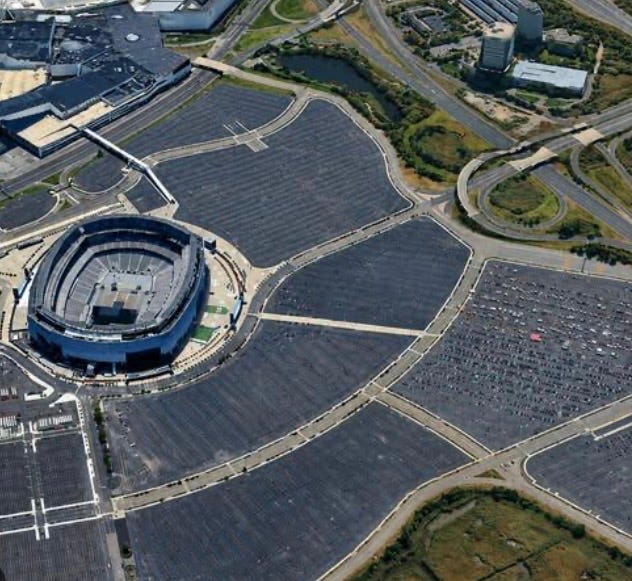
Streets are no longer paved as corridors into a societal room, but replaced with motorways and sidewalks. “The urban commons” is suddenly privatized, transformed from a square into a parking lot. The little clothing boutique, the newspaper kiosk, the quaint corner cafe is replaced with superstores and strip-malls.
This is the exact opposite of the traditional piazza-culture of the Latin world, which spreads its social functions across a wide span of smaller establishments. They gather under the welcoming form of an enclosed urban space, as a hen gathers her brood under her wings.
The suburban culture collects these social functions in places spread far and wide, imposing further material necessities to connect them, such as cars and credit cards, while the less economically fortunate must rely on public transportation. Thereby it has split form from function, fatally undermining “the urban commons.”
The Problem with Transit Spaces
Few citizens would consider subway-stations and bus-stations as good social spaces in which to gather with friends at night. While they can at times be the most practical meeting points of a city, they can never be confused with societal rooms since nothing happens there, except for the frustrating activity of waiting and a growing expectation to be somewhere else.
At best the subway-station or the bus-station has a water fountain and a vending machine. Otherwise they serve no other function than to provide a space where citizens can get on or off a train or a bus.
In order for these public waiting rooms to become societal rooms within “the urban commons,” they must offer citizens a greater span of activities. For example, there must be an inviting coffee shop, maybe one that is open past sunset, perhaps a movie theatre and a croissant bakery which serves fresh pastries at night.
But even if all these suggestions were realized they would still not amount to anything if people choose not to live around these transportation-stations. Few urban developers see much promise in housing projects around these areas and even fewer citizens wish to move to them. For this very reason the only people drawn to them tend to be gangs and criminals, who crawl out of their trenches at various hours of the night. It’s a veritable no man’s land which these urban warriors may freely occupy without any social resistance.
The Exclusive Line
This also explains why criminal activity moves into the deserted downtown areas, even if these same areas might contain the Concert Hall with adjacent champagne-lounges and French restaurants. The pivotal factor is that the societal room has collected the patrons within its radius and moved them all indoors behind an exclusive line.
Thereby the concert audience and the restaurant guests are locked up within their own society, while the other societal room outside their doors — the would-be “urban commons”— is the only thing open for those who aren’t going to a concert or to a restaurant. The open societal room of our city is then only open to those who have nothing to do there, transforming this urban space from an architectural shape meant to serve the body politic into an urban dead-zone, a necropolis.
If fewer people live downtown, if the evening attractions grow ever more exclusive, if the daylight hours bring more pedestrians than street lamps, these downtown areas become no different than subway stations and bus stations for those without money, who search the streets for a place they might belong, or spend the night.
The Direction of Causation
A self-destructive urban phenomenon may unfortunately appear anywhere on the public map. That’s the bad news. The good news is that it does not appear within an “urban commons” which remains intact.
It’s symptomatic of an unhealthy urban environment, from Wall Street to Main Street, if these areas become depopulated and alienated from the wider social life of the city. The problem will not only be evident in the low number of residents there, but in the lamentable fact that people will only go to these areas for a very specific purpose.
We see symptoms of urban decay if, after a performance, concertgoers leave the downtown Concert Hall by hailing a taxi towards another area of town. However, it’s important to note that it’s not the taxi-hailing concertgoers who, by abandoning this common space, open it up for gangs and criminals. It’s rather the other way around. The common urban spaces have abandoned them.
These areas become criminalized through a deconstruction of “the urban commons.” Any downtown which deconstructs its social functions will experience the same abandonment and criminalization. If there are no longer any establishments, any markets or businesses which encircle the auditoriums and the theaters, then there will be no civic downtown, only an increase in convenient parking lots.
Should “the urban commons” become an urban desert, it not only witnesses to an anti-urban prejudice, but it witnesses to a violent assault over and against our most natural form of life, long before the gangs arrive to complete this criminal action.
Getting the Order Right
While cities need to remain attractive to the surrounding world by investing in concert halls and stadiums, they need to be placed appropriately, at the appropriate time. Neighborhoods are delicate ecosystems. Naturally, everyone enjoys a sporting event, a movie or an opera, but these venues never give birth to “the urban commons,” instead they complete them.
It would be better to treat neighborhoods as villages. What every village needs is architecture, not just a row of buildings. In order to curb violence and crime among its inhabitants, cities need to invest in handsome housing, public art and churches, temples and Cathedrals. They need cafes and bars to be open at night, after the bakeries and boutiques close their doors for the day. They need a busy open air market instead of a strip-mall parking lot, and they need local eateries instead of fast-food chains.
After these things have been accomplished, after the implementation of perennial urban principles, cities may pour the foundation for a new concert hall or athletic stadium.
The error of so much modern urban planning is to reverse this order: they build the monument first and hope the community follows. But community cannot be summoned by spectacle. The concert hall completes a living downtown; it cannot create one. The stadium crowns a thriving neighborhood; it cannot conjure one into being. First the bakery and the butcher, the cafe and the market, the housing and the church. Only then the grand venue.
We have inverted this wisdom across the western world, building gleaming arenas surrounded by parking lots, wondering why the surrounding blocks feel dead, why crime creeps in after dark, why no one lingers once the event has ended. The answer is simple: we built the crown before we built the head that should wear it.
Nowhere is this seen more plainly than in a city that has already finished dying.
Pax et Bonum!
C. W. Höjer
Next: a dispatch from Ephesus, where the harbor silted, the people left, and nothing remains but the commons itself: open to the sky.