

Part 4 of a series on good and bad government in place and time
On an inscription above the door to Plato’s academy it was written, “Let none but geometers enter here.” Geometry naturally set limits upon how many ways one can draw up a plan for an urban republic such as the one Plato dreamed about. Squares and triangles can be repeated in a regulated pattern, where every latter section resembles the preceding section.
When all of our facades represent buildings which follow a right-angled street, it’s natural to expect that every street will eventually meet another street between four corner buildings on a crossroad. Several villages, towns and cities, but even more neighborhoods, are designed according to such a pattern.
The Grid and Its Discontents
The right-angled city is the easiest to draw and the grid-planned city is the quickest to build. It’s also the easiest to map out and the most convenient design for accommodating automobiles. But it’s not always the easiest for mankind to find his way around in, oriented as we are towards the multifaceted truth of life and not the mere fact of life.
Since all forms are strictly speaking geometric, every urban block in such a neighborhood of buildings are thus the same, making it impossible to lose our way, perhaps, but very difficult to recognize where we are. Any tourist who’s ever wandered around the Haussmann districts of Paris must be forgiven if he forgets which streets leads him to or from the Bois de Boulogne. The same experience is reported wherever his geometric legacy has cast a light or a shadow over the urban plan, such as the Prati district of Rome, the Östermalm neighborhood of Stockholm, and the 1909 Plan of Chicago.
The Limits of Geometric Planning
Every student of Euclidean geometry knows that mathematical figures can be organized in many ways. They can be ordered according to an intellectual axis of parallels and crosses, or they can be organized according to a central principle such as the masculine rectangle and a multifaceted pentagon. They might even be organized with the sharp, dramatic angles of two overlapping squares which jut out like a star. Or they might be linked together in a softer, more feminine pattern, such as the oval or semicircle and according to other irregularities which help to make the urban space more inviting and welcoming.
However, the latter, more feminine approach, has never been the preferred method for a comprehensive urban plan. The overwhelmingly male theoreticians have since time almost-immemorial confirmed that we have the grid pattern, the axis pattern, and the central pattern to choose from. They add that we can either categorize our cities into the classical tightly enclosed city, the modern openly functionalist city, or the city within a garden of the “city beautiful movement.”
Hence, there is nothing we would call an irregular city. Yet every city we can think of is blatantly irregular. How can this be?
The Reality Beyond the Blueprint
Even if every city we visit has its roots in an original principle of urban organization, even if all the neighborhoods of these cities together exemplify every type of pedagogical pattern, the fate of human mortality have without exception altered the original plan. Urban development has passed through so many contrasting epochs and its evolution has passed through so many competing considerations that the result has almost universally become a sort of architectural potpourri.
Guidebooks in hand, we begin to make out combinations of these various schools of urban renewal and then combinations of certain elements of these architectural schools, until the parade of human endeavor reaches a point where we surpass Euclid’s geometry. In this new non-Euclidean geometry we enter a world that is no longer a flat blueprint, but a spherical plane, where universal definitions give way to nominalist ones, beyond numbers and names, into a more rounded reality. One might even say into a more inviting, feminine, irregularity.
Happily, we don’t need to visit a university lecture on urban logic and postmodern mathematics to perceive this reality.
A Walk Through Rome’s Irregularity
Let’s take another stroll down the streets of Rome, the most urban of all the cities in the world. Let’s exit Rome from the Porta Flaminia, the northernmost gate of the city. Then we quickly enter an area known as Quartiere Flaminio for those that don’t live there, but which is an area with many neighborhoods for those who have their addresses here.
It runs from the famed gate re-dedicated by the popes to the convert regent, Queen Christina of Sweden, and then extends over Via Flaminia across the Ponte Milvio bridge where Emperor Constantine had his famed battle against Maxentius, which initiated Rome’s conversion to Catholicism. From an urban planning perspective, these neighborhoods are only united by a series of disunited areas, yet such wounds in the design-pattern have an organic tendency to heal nicely as intriguing scars.
We walk through grid patterns and axis patterns; through a grid pattern between the Porta Flaminia and the Marine Ministry, through an axis pattern when Via Guido Reni decides to divide a grid pattern in half. In the grand bird’s-eye view perspective, Rome cannot be said to have any central axis in this area, but when we’re walking through the streets the urban experience is more of a worm’s-eye view perspective.
In many places we see that streets will break off into other roads or diversions, as when a beam of light is broken into other colorful directions through a glass prism. Suddenly the beam of light that was Via Guido Reni is broken by Piazza Apollodoro where it dances around the Palazzetto dello Sport. Then we can be thrown back into Piazza dei Carracci where a slightly crooked Via Flaminia will carry us to the Oratorio di Sant’Andrea, and before we know it we’ve been placed on the banks of the Tiber River.
Perspective Shapes Reality
The entire walk is composed of such street patterns which, formed by a developmental law, explain why Via Flaminia is the axis of a grid-pattern when we approach it from the south through Porta Flaminia, but becomes a central radius when we approach it from the north into the round traffic circle of Piazza dei Ponte Milvio.
A street’s nature is namely not only dependent upon its architectural direction, but upon the pedestrian’s direction when he walks the street. In other words, our perspective is conditioned by our point of departure; where we stand governs what we see.
If we continue on our walk within these variations of urban construction, we soon come upon yet another combination: the enclosed city which opens itself up, as a flower, towards a city within a garden. Finding our way through Via Condotti up the stairs of The Spanish Steps to Viale Trinità dei Monti, where the grid-pattern is dutifully preserved, we find the famous villas of Villa Medici, Casa Valadier and Villa Borghese which soften and break apart both the urban grid-pattern and the tightly enclosed city.
The first thing we notice is not that organic urban organization contains within itself such a mixture of developments, but that it’s in these irregular transitions where we know where we are, where we don’t feel the same necessity to look at a map to know where we are. The utopian geometry of past architects hold no stronger power than that the gardens of Villa Borghese become a wandering milestone along our walk through the city. It’s organic, it’s natural, it’s reflective of our humanity.
Even pedantic formalists with elbow patches and logarithm tables must admit that Dante found his way back home through a wild wood, having lost his way on the straight and true.
The Lesson of Siena
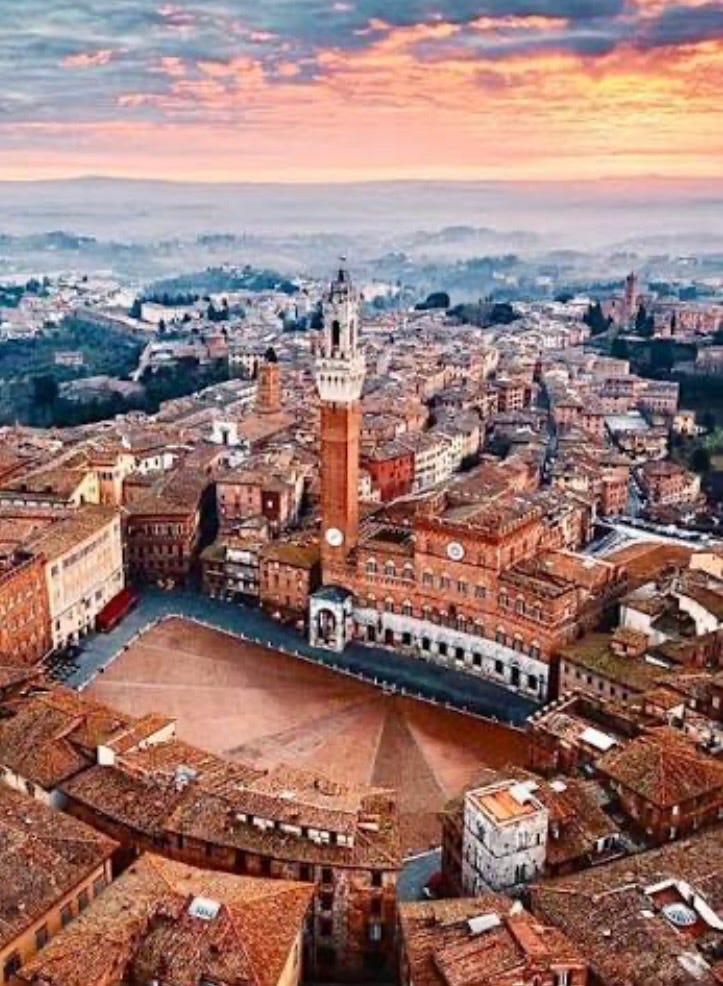
By studying a map of the town of Siena, in Tuscany, we can see that it has a completely intact medieval wall surrounding the old town, which, in turn, still represents the historical core of the surrounding new town. A bird’s-eye view of the town clearly shows us that medieval and renaissance Siena, protected by a Medici-family fortress outside its city wall, lies as the heart of a larger urban body which has continued to grow with a more modern plan, representing the new riches of a new age.
We can clearly see that the modern town is regulated by a more functionalist city plan which takes over the cityscape right outside the brick walls. These new roads and traffic circles leave the ancient gates as they wind their way around the natural landscape as so many wide strands of pappardelle pressed through a pasta machine.
The bird’s-eye view also tells us that history has bequeathed to posterity a towering gothic church, an open square, crooked streets and bent alleyways.
However, I still remember the first time I visited there, when I came upon an important realization: in the modern neighborhoods of Siena, where livelihoods depend on commerce and industry, reflected in the straight and true of a well-regulated urban design, we lose our way. But, once we enter within the city walls, the bent alleyways and crooked streets of the historical center unceasingly leads one by the hand—manuductio—to the public living room beneath Town Hall, Piazza del Campo.
In other words, while maps never lie, mapmakers do, for bird’s-eye views can never replace the experience of treading across those medieval streets.
When Theory Meets Reality
Architects tend to be passionate cartographers. They can enclose themselves within their minds, within their studios, and draw maps of a city they would like to build. They feel an inherent need to form spatial solutions across a wide plane, to hold a blueprint of reality in their hands. Admittedly it’s an important aspect of the visual intellect, but it’s a poor imitation of the reality outside their studios.
Something amazing tends to happen when we walk outside to meet the world, namely, the world comes to meet us in turn. It was in the month of April when I first strove around the medieval streets of Siena, and I was on my way from Rome to Florence. In the regional bus that took me there I had been studying a local map shortly before I saw the hilltop town appear through my passenger-side window.
I had heard about this famous tourist attraction, so I expected to find a cultural exhibition of an otherwise dead city within its walls. After we had pulled into the parking lot before a church dedicated to Saint Catherine of Siena, I no longer felt the need to study my map, for I had, so to speak, stepped into it.
Moments beyond the first city gate my feet were led by a cobblestoned guide through the myriad labyrinth, where after a few minutes I stood under the shade of the Torre del Mangia, next to Town Hall on the shell-shaped Piazza del Campo. From the piazza, I could count eleven narrow streets which radiated into the cityscape.
The Categories of Beauty
I remembered something I had read about the categories of beauty, for around me I saw Integritas, “wholeness,” in its harmony with the ground, I saw Consonantia, “proportionately,” in the symmetry and arc of the Gothic houses, and I saw Claritas, “radiance,” in the sunburst pattern of the concave square.
As I marveled at the beautiful vitality of the commerce and its patrons, I understood that this was no dead exhibition—the urban organization was an organism. The city didn’t just contain life, no, life contained the city!
Somewhere outside this square, outside the walls, the modern Italian city had been constructed according to the dictums of functionalism in order to facilitate efficiency and materialism, yet a university campus displayed many more invigorating signs of diversity and vitality. However, between those medieval walls from the age of Christendom, in a city which could never compete with modern industry or transportation, there passed a breath of fresh inspiration.
I thought to myself: a contemporary life can also look like this, and children can grow up here as well. I filled my lungs with this healthy spirit, as I sat down to drink a cappuccino. I had walked into a piazza, for I was inside a city, where one is never outside, but always at home, within a community under Heaven.
What Siena Teaches Us About Good Cities
The lesson of Siena is profound and simple: the crooked medieval streets lead us home more surely than the rational modern grid. Not because irrationality is superior to reason, but because human wayfinding operates on principles deeper than Euclidean geometry.
We find our way through landmarks, through memorable turns, through the experience of moving through space toward a destination we can sense even before we see it. The medieval builders of Siena understood this intuitively. They built streets that followed the contours of the hill, that created memorable vistas, that channeled movement naturally toward the center.
The modern planners outside Siena’s walls built streets for automobiles and abstract efficiency. They created a landscape where every block looks like every other block, where finding your way requires constant reference to a map, where there are no natural gathering places because there is no natural center.
The Final Question
This series has explored how cities embody moral and political visions, how they contain nested hierarchies of belonging, how different urban organisms achieve unity through different means, and how geometry both enables and limits urban life.
The fundamental question remains: Are our cities made for virtue or for greed? Do they facilitate human flourishing or commercial efficiency? Do they create spaces where communities can form naturally, or do they impose abstract patterns that ignore how humans actually navigate and inhabit space?
Siena, with its crooked medieval streets that lead unfailingly to the communal heart, offers one answer. The grid-planned suburbs and functionalist districts offer another. The choice between them is not aesthetic—it’s moral. It’s about what we believe cities are for, and therefore what we believe human beings are for.
Every zoning decision, every street plan, every choice to preserve or demolish, to build high or low, to prioritize cars or pedestrians, to create public squares or private developments—all these seemingly technical decisions are actually theological and philosophical statements about the nature and purpose of human life.
Not all cities are created equal. Some lead us home. Others leave us perpetually consulting maps, searching for a center that was never built.
Pax et Bonum!
C.W. Höjer
This concludes this little series on good and bad government in place and time. From the drama of urban virtue to the nested hierarchies of community, from Rome’s unity to Istanbul’s reinvention, from abstract geometry to lived experience—we’ve explored what makes cities good or bad not just aesthetically, but morally and politically.
The question now is: What will we build? And for whom?