

Part of my ongoing series on good and bad government of our cities in place and time
After exploring the ancient origins of cities—from the archetypes that preceded Vitruvius, through the political development from Jericho to the nation-state, to the architectural language that speaks across millennia—we turn now to a living example. How do these principles manifest in an actual place? What does it mean for a city to preserve its essence while remaining vital?
A particular town in Maine offers answers to these questions. It’s called Kennebunkport, a small coastal town incorporated in 1653, when it was subject to the Massachusetts Bay Colony. One arrives driving steadily on Route One, which stretches for miles along the eastern border of the United States with the wide Atlantic on one side and the wide expanse of land on the other.
This New England coastline is famous for its lobster industry. The saltwater lobster, which was once served to New England prisoners, has since become a delicacy and a source of local pride—there is even a lobster mosaic in Pompeii suggesting how much the Romans valued this food. Eventually we catch a glimpse of Kennebunkport, and perhaps it’s the thought of melted butter and lemon juice which lends a particular taste to our expectations of this old maritime village in modern America. “Man needs to know but little more than a lobster in order to catch him in his traps,” said New Englander Henry David Thoreau.
The Maritime Village Intact
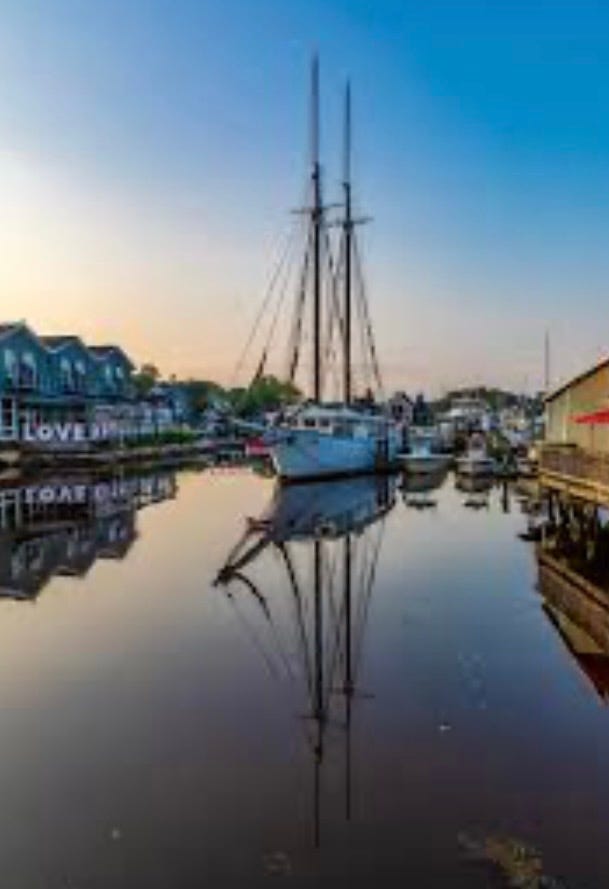
In the next moment one is surrounded by seafood eateries and fisherman’s restaurants serving various incarnations of the catch of the day, recently hauled inside the bay from the Atlantic Ocean. We can catch a glimpse of lobstermen stacking their traps or fishermen hanging their nets along the harbor. A flotilla of boats lie bow to bow on the water, some tied to docks, others tied around mooring buoys, floating between the buildings of Kennebunkport which hug their beloved inlet. One finds the historic Colony Hotel across from The River Club, under a sky which has become an ocean of seagulls.
Kennebunkport is home to a presidential headquarters, the Bush Family compound, which brings modern America and the globalized world order into this coastal village. But the visitor also experiences it as charmingly old fashioned, protecting rich treasures of a long history. Some of her inhabitants even trace their heritage to the pilgrim-ship The Mayflower, and from the late nineteenth century a steady stream of American tourists have nourished both body and soul along her colonial streets and vernacular alleyways.
The Biblical Foundations of New England Urbanism
Kennebunkport shares her genesis with the city Boston, which was an ambitious project, founded as “a city on a hill,” with the eyes of all the earth upon them, to quote a sermon by John Winthrop from 1630. This courageous Atlantic Crossing, which signified European man on new soil, must be considered as a political experiment stemming from our deepest hope for a better tomorrow, as much for their times as for our own.
The great western expansion during the Age of Sail had its economic reasons, many sharing the goal to dig, mine and search for gold, silver and copper. Yet the original, deeper motivations of religion and government never left these shores. The Puritans of the Massachusetts Bay Colony traced their noble silhouettes against a biblical background. As the Israelites had crossed the Jordan River, the Puritans were crossing the Atlantic Ocean. As the Israelites had entered Canaan under Joshua, the Puritans, under Winthrop’s leadership, were now entering a new land, brimming with promise.
While the temptations for the Israelites were the false Canaanite gods, the temptations for the Puritans were the false gods of pleasure and profit. This image of a shining city on a hill would retain its power throughout American history, later defining America’s self-understanding during the Cold War, under the leadership of Presidents Ronald Reagan and George Bush.
However, John Winthrop had meant it as a warning: if America should fail as a shining city on a hill, the whole earth would witness their demise. So their hope for the new towns along this coastline was that civilians across the world would pray that the Lord might make their communities resemble those in New England, which combined ancient views of political life with traditional Christian virtues.
From Augustine to Aristotle on American Shores
The founders of New England believed that God had chosen Man as his deputy to rule the earth. Winthrop emphasized that God chose to work through his creatures to bring about His will in society. But the original society of Adam and Eve had allowed pleasure and wickedness to prevail against their duty, making God’s natural law within them insufficient for government. The punitive law of a just government was therefore needed.
The Puritans were quite clearly echoing St. Augustine in this conviction, who had held that government was a result of The Fall (original sin), while also anticipating James Madison who would famously be attributed as saying that if men were angels then government would be unnecessary. Still, their purity and education compelled them to preach that government also cherished those who do good, that judicial administrations were still capable of kindness and charity.
For even if Adam and Eve had never fallen, government would still have coordinated mankind for the common good of the political community. As Aristotle had claimed and as St. Thomas Aquinas had reiterated within a Catholic context, man is a political animal. This intellectual orientation towards the political philosophy of the Old World was a natural East/West relationship for New England. While it was undoubtedly the case that the Puritans were disappointed in Europe, New England retained a loyal devotion to their western heritage.
Old World Wisdom in the New World
One might think that such ancient tradition might not have survived an Atlantic Crossing, that Kennebunkport must have developed into a secular enterprise, that it’s only an antiquarian enthusiasm inside the atrium of the Colony Hotel which momentarily carries one away inside a palette of sea-worn colors to Piccadilly and Parnassus. One might be forgiven for such thoughts while sitting with an old book on well-worn furniture.
Yet when later in the seventeenth century John Locke would write to anyone disappointed in the social contract of England that they could then travel into the vacuis locis, into “the empty places,” to start anew, he wasn’t referring to Puritan New England. The pilgrims of the Atlantic Crossing navigated between the old and the new, towards new lands using old charts, expecting these Elysian Fields to be filled with both ancient wisdom and modern challenges.
In Kennebunkport one is neither in Portland nor Boston, two nearby coastal cities which can at times seem degraded in their modernity, in particular by the size to which they have grown. Kennebunkport is not only less famous than the other two, and much smaller, but above all the only one which can still boast to being what it originally was: a harbor town inside an inlet.
That’s why there’s still a cozy atmosphere stretching from Dock Square to the marinas along Ocean Avenue. The cottages on Cape Arundel still form the backdrop to the shingled homes which reflect their wide porches onto the water. Caribbean waiters, dignified and swift, serve their summer patrons on white wicker chairs.
One thinks momentarily of the ships from Spain, which set a course for ports in Havana and Santa Domingo. One thinks of the Caribbean Nobel laureate Derek Walcott and his poems about identity and integration. But here in Kennebunkport the inhabitants remember writers such as Harriet Beecher Stowe, who, while living along this coastline, was inspired to write Uncle Tom’s Cabin, a story which was sympathetic to the plight of slaves in the United States. Highly controversial at the time, it became a symbol of the abolitionist movement.
They also remember Henry Wadsworth Longfellow, a visitor from Portland, who was the first poet to use the American landscape and the Native American as the focus of his work. The inhabitants of Kennebunkport say their town encapsulates nearly four centuries of American culture.
The Ritual of Place
At dusk, visitors and locals wander in the yellow glow of shop windows, hanging lights and ship lanterns. The gentle bobbing of fishing boats animate the docks below a glittering line of lobster shacks and breweries. They guide one to choose from a row of eateries along the inlet. At times it can seem that opening a new seafood restaurant is a local obsession.
Eventually we choose a handsome table, preferably outside, to fully enjoy a true maritime ritual. The menu seems more expensive since last year, but it’s soon forgiven as a moon river flows into the Atlantic. Only some yards from the tables lie the same ships who earlier in the day hauled our dinner from the blue depths.
The menu begins with Maine oysters from a cold, fresh, clean ocean. We bring the shell, with a drop of lemon juice, to the lip of our mouth, before we chew and swallow. Then we order swordfish and a Haddock fish chowder. Before the evening comes to an end we suddenly decide to enjoy a plate of steamed lobster as well. We’re in Maine, after all.
Paired with all this delectable seafood we drink a pint of local Shipyard ale and feel as a wayfarer inside, complete with a salty brow and a briar pipe. Our body feels reinvigorated and our soul wants to sing English sea shanties and swelling odes about these distant ports in Far Arden. We lean back and look around, wishing we lived here all the time.
This is what the Romans understood when they built their cities around the forum, what the Greeks knew when they designed their agora. The city exists not merely as shelter or commerce, but as the stage for human ritual, for the daily practices that bind us to place and to each other. In Kennebunkport, this ritual centers on the sea, on the harvest of lobster and fish, on the gathering at dusk to share the bounty together.
Pax et Bonum!
C.W. Höjer
Next post: The lesson of Kennebunkport—how America’s founding was not born from abstract philosophy but from the lived reality of local communities.