

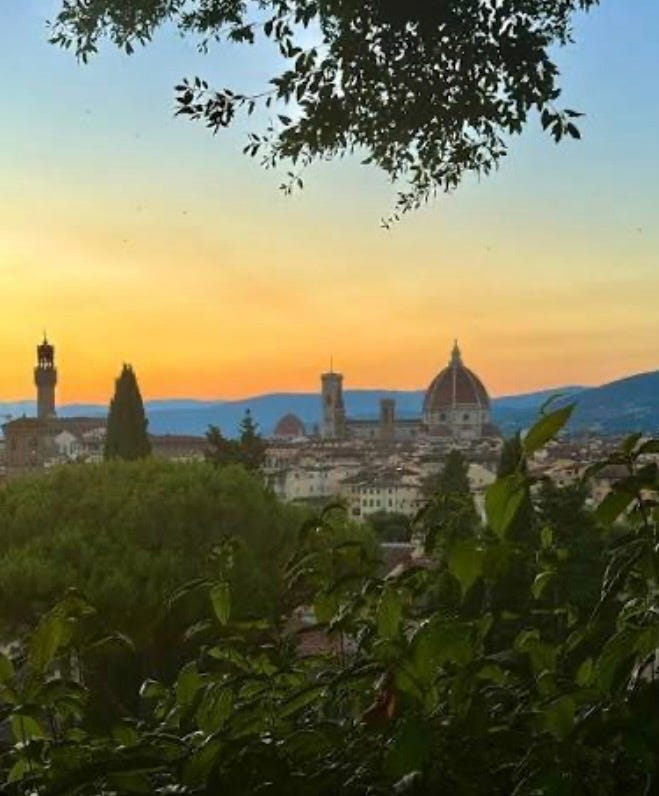
Florence has often been hailed as the most beautiful city in the world and blessed are those tourists or residents who can judge this claim for themselves in the footsteps of Dante, Michelangelo and Brunelleschi. But if we spend a day sitting on Piazza Santo Spirito, in the Oltrarno neighborhood, we may actually gain a better understanding of city-living in this Tuscan town than any amount of information we may acquire on the many walking tours offered by the tourist board.
If we take the time to spend such a day watching as life passes us by on a city square, we will probably learn more about urban phenomena than any amount of academic research promises to attain for us.
Dawn
At dawn, with the first rays of the new rising sun displacing the moon, the piazza wakes from her slumber. A church door flings open for morning Mass. The creaking of old carts announces the arrival of the vegetable sellers. They’re lifting boxes, carrying bags, opening parasols and securing their tables. Then they’re joined by the fruit sellers, the clothing vendors, the cheese makers, the butchers and the bakers. All of them bring their treasures to the square as they’ve done all year, in every season, since time immemorial.
The first customers arrive in lockstep with the morning rays which begin to shine through an alleyway and bathe a curve of the square in light. In that sunny spot, the first coffee shop opens its doors to the local patrons, the young and the old, who enjoy a pastry, a cappuccino and the headlines of a newspaper. The relaxed authenticity of the piazza feels natural, inviting us into its ecosystem.
An elegant gentleman leaves the cafe in mid-conversation with the barista on his way to the office. A group of languid locals discuss soccer and politics over a cigarette as they lean against the fountain at the piazza’s heart. As the golden globe of the sun rises higher over the rooftops, the population increases in both density and volume across the square. In the space of a few hours all of the businesses have opened their doors to the public.
Midday
Then the pace begins to quicken as the various eateries, the Osteria and the Trattoria, begin to prepare for lunchtime. Each owner scurries around his establishment, preparing the outside tables, expertly aligning them in order to occupy his allotted section of the public living-room. Lunchtime coincides with that wandering light of Heaven we call the sun. If one stands upright to look at the clouds, one can almost count the seconds until the sun reaches its zenith in the sky.
Within arms reach of the perfectly medieval market sellers, we sit and eat from dishes piled high with the same seasonal delicacies that they are selling: fresh spinach, beans or tomatoes in paper cartons, fresh spinach, beans or tomatoes on our plates, and rotten spinach, beans or tomatoes in the gutter. We hear orders for *affettati, crostini, crostoni, schiacciata, trippa, lampredotto, patate, fagioli all’uccelletto, spinaci, peposo, frattaglie, ribollita, pappardelle, pappa al pomodoro*—not forgetting the jewel of the Tuscan kitchen: La Bistecca.
The well known aroma of gnocchi under a truffle sauce emanates from the hands of a waiter as he passes our table.
Afternoon
When we begin to consider a dessert, the market stalls are taken down as vendors pack up their goods to gain some rest before another early start the following morning. Now the municipal cleaning crews arrive in the piazza to collect their scattered debris. The street sweepers brush the cobblestones until doves search in vain for seeds and scraps. The lull of the siesta settles over Piazza Santo Spirito.
The eateries close for the afternoon, but the wine-vendor keeps an open door for the rest of the day. When he’s not selling bottles of Chianti, he runs a bar for the people dipping in and out of the square. Leaning our elbows against his wooden counter, we gaze out over the square where satisfied diners disperse into alleyways to other corners of the city. Students and professors, priests and tourists, move together across the public living room, which has been transformed from an arena into a crossroads, for suddenly no one has their daily business here anymore.
Therefore it seems quite natural for us to take a stroll through the surrounding streets ourselves, in search of new cultural delights, while we wait for something to happen.
Evening
Every time we cut across the square, as dusk draws nearer, we notice a change. When the first glimmer of evening coats the city with an orange hue and the golden glow from the lampposts becomes more pronounced, there’s some movement behind the doorways. Suddenly people emerge from inside their establishments and start to animate Piazza Santo Spirito once more.
Voices raise their volume again and there’s the sound of aperitivo with clinking glasses, filled to the brim with Aperol Spritz. It’s a wonderful sight, as the drink’s bright orange liquid matches the hues of the sunset. Out on the square it’s the hour of whimsy and revelry. Someone strums a guitar, friends embrace over the cobblestones and we grab one of the few empty tables ourselves. Where we sit we can recognize the faces of those who have visited and revisited this square throughout the day.
Night
The piazza is still alive as shadows fall when the sun goes down, fueled by food and drinks, chance meetings and conversations over the dinner tables. As we finish the last bites of our Florentine meals, the entire square transforms itself into one giant bar as sitting guests combine their parties and others stand or perch with their friends.
First as night draws near around midnight, one can experience Piazza Santo Spirito as an abandoned living room. Only Cosimo Ridolfi, opposite the church, stands alone on his pedestal. He was the founder of l’Accademia dei Georgofili which promotes the “art of Tuscan cultivation”—in other words the arts of agronomy, economy and geography.
What the Piazza Teaches
This rhythm—dawn to midnight, market to meal to gathering to silence—isn’t planned by urban designers or mandated by zoning boards. It emerges from the simple fact that the piazza serves multiple purposes throughout the day, that it belongs to no single use or user, that it accommodates the full spectrum of urban life.
In the morning it’s a marketplace. At noon it’s a dining room. In the afternoon it’s a crossroads. At evening it’s a gathering place. At night it’s a bar. And through all of this, it remains a public living room—a space that belongs to everyone precisely because it’s claimed by no one exclusively.
This is what good cities understand: urban space works best when it can transform itself throughout the day, when it serves the baker at dawn and the student at dusk, when it welcomes the priest to Mass and the guitarist to play, when the same cobblestones that host a vegetable market in the morning become a stage for conversation at night.
The tourists who rush through Florence collecting photographs of monuments miss this essential truth. The real beauty of the city isn’t in its museums or churches, magnificent though they are. It’s in the daily rhythm of a square that knows how to be many things to many people, that pulses with life from sunrise to midnight, that creates space for the full range of human activity without needing to announce what it’s for.
Piazza Santo Spirito doesn’t need signs or rules to function. It needs only what it has: good proportions, human scale, flexibility of use, and a community that knows how to inhabit it. Everything else—the market, the meals, the music, the conversation—follows naturally from these simple conditions.
This is the lesson every modern city planner should learn by spending a day on a Florentine piazza: don’t design for a single use or a single hour. Design for transformation. Design for rhythm. Design for life as it actually unfolds across the course of a day, and trust that people will know what to do with space that truly belongs to them.
Pax et Bonum!
C.W.Höjer
Connor and I spent part of our honeymoon in Florence - and much time in the piazzas of Italy! So true how they transform with the length of the day.