

Why we recognize Rome in its streets, not its monuments—and what “the urban commons” really means.
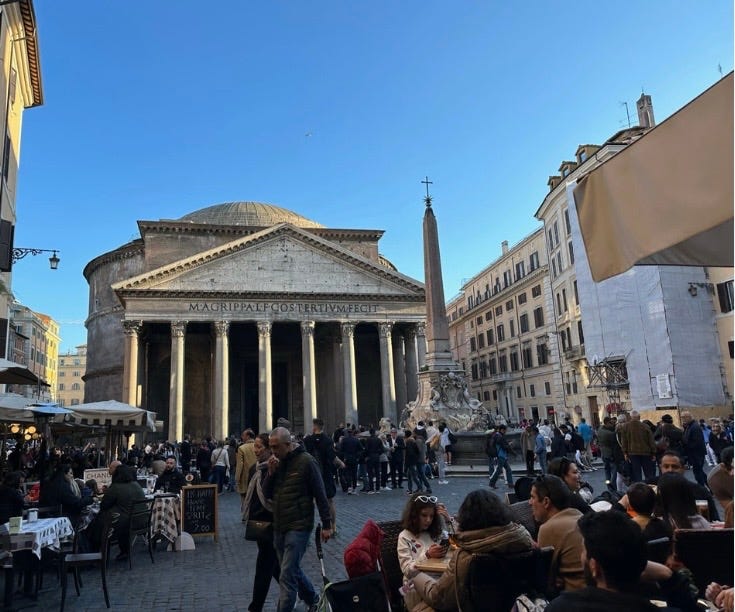
A city is not only composed of its buildings, as music is not only composed of sound. In equal measure a city is composed of space, as music is composed of silence.
We’ll never know we’re in Florence, Siena or have entered Rome by checking into our hotel room or standing in front of Michelangelo’s David, The Duomo or under The Sistine Chapel. No, it’s rather in the in-between spaces, as we transport ourselves through the city from one place to the next, that we recognize where we are.
Even if the Statue of Liberty in New York City, Big Ben in London or the Eiffel Tower in Paris are urban profiles which we easily identify with an individual city, we never encounter the city in front of these monuments. Nor is what happens inside The Stock Exchange, The Houses of Parliament, the Élysée Palace or behind any number of powerful facades across western civilization more important for our urban life than what happens outside on the street.
As in a musical composition, urban life is actually to be found in movements and transitions. It’s to be found between the outside and the inside, in the doorways, in the thresholds to churches and museums, to clothing stores and business offices, to schools and train-stations. It’s on the outstretched floor of our common ground, between the play of crosswalks and squares, where men and women walk in and out of each other’s circles—in “the urban commons” of our cities—that architecture can embody the necessary harmony and space within the metropolis.
How Space Takes Shape
If we walk long enough back and forth across our cities, we may observe that the shapes of our big urban spaces can be divided into many smaller individual shapes; we may even observe that these shapes can change their forms. Architectural shapes weave themselves into the social fabric, producing new existential spaces.
A local florist who has placed a bucket of bouquets outside his storefront has expanded the allotted shape of his private business by borrowing from the common space. The owner of a local coffee shop who has expanded his business by placing a table and two chairs outside his establishment is advertising to the passerby that “the urban commons”—the common ground which exists outside his doors—continues inside his own cafe.
Perhaps we will never feel at home in a city before we know the do’s and don’ts of the common spaces, of the shared living spaces, of how we are to use “the urban commons” of a city.
A Seat in the Theater of the City
We can enjoy an instructive vision of how urban shape and space interweave with our lives by sitting down at one of the numerous squares of the western world. By allowing our legs to lead us down to Piazza Rotonda in Rome, Taksim Meydani in Istanbul, Place Dauphine in Paris or Praça Rossio in Lisbon, we first choose to approach a cafe which attracts us in some way, then we choose an outside table in the back row close to the facade.
From this position we have an auditorium chair for the stage-play going on in front of us, where we let our neighbors become our actors, coming and going across our common ground. From this position we have built an invisible Odeon around us. Behind us are customers who walk in and out of the coffee bar, in front of us they also walk in and out of the row of tables, while around us people walk in and out of the common ground.
Some of our neighbors make an entrance upon the square, while others exit. They not only enter from various alleyways and hidden turns, they’re also opening and shutting doors to the sound of locks and keys. Whenever they step out into the square, they’re inside the play of the city, which brands them with a particular identity, a visible character, for citizens live in a city as much as the city lives in them, whether for a lifespan or if only for an afternoon.
Few pictures can summarize the interplay of spatial and existential relations better than the vision we receive on any of these famous squares, but the same thing happens in every town as well. Whenever restaurants or bars place tables and chairs in front of their establishments, we enter under the canopy of the common grounds, even if we’re walking outside on the city streets.
Listening to a City, Not Lording Over It
Regarding the do’s and don’ts of “the urban commons,” it’s important to listen to a city and not merely to lord order over it. If we are to sustain healthy norms for our public life, then our common living-rooms must be kept open and alive, especially if we are to avoid violence and delinquency.
The tightly built cities of The Classical World repeatedly show us that social constraints are often more effective than legal prohibitions. While working to avoid vicious acts in our cities, we must not attempt to crush them by oppression, for if our cities are to remain virtuous, they must also remain open to vice. It’s a facet of western Christian civilization that we recognize a virtuous society from a sinful society by its vulnerability to being undone by people who make the wrong decisions.
In order to understand this perspective, we may recall the stress placed on the family and family-life as the basic unit of society. The virtuous society within Christendom is therefore normative, not legislative. This makes perfect sense, since if citizens are meant to inhabit a city, they must learn to live with it as well.
But if we take the Puritans of New England as the guiding star for how to organize “the urban commons,” then it’s the politicians themselves, by enforcing certain law codes over our public houses and public squares, who exercise violence against their own cities. Famously, often infamously, the Puritans of The Massachusetts Bay Colony banned Christmas festivities from all their public spaces, which would otherwise have been filled with people coming in and out of open establishments, both singing and dancing on the squares.
The City as Ecosystem
If we picture all the people of the world who don’t live in a bucolic village, but in high-rise buildings and apartment blocks, a walk to their local coffee shop can be as liberating as a stroll through the countryside. When going outdoors to meet friends and family necessitates going inside a cafe or a beer house, usually due to weather conditions, we’re still “out on the town.” Likewise, if we meet friends and family outdoors on the square, we’re still inside the city—namely, inside the city’s outside spaces.
Since a city is animated by our family-life, it might be compared to a well-balanced biotic system, where human beings are dependent upon the proper functioning of its particular ecosystem. Whoever wishes to destroy a city doesn’t need to study tactics of war and peace, but the organization of crime and punishment. He needs to destroy its social ecosystem.
Whoever wonders about the causes of urban violence and delinquency needs to study the perpetrators of political violence upon “the urban commons” and the rules and regulations which violate its being.
What Defines a Societal Room
A city without common social gathering spaces is a city which has lost its essential completeness. Urban nature requires societal rooms. Sometimes this is referred to as our “third spaces,” which are neither our homes nor our workplaces, yet they may be some combination of these. Should these spaces be absent from a city, we may be justified in asking if it’s a city at all.
It’s not a question of designing parks and squares, it’s not a question of physical shape and open space which defines a room—rather it’s a question of use and functionality which defines “the urban commons,” that is, a societal room. A narrow alleyway around Montmartre in Paris can become a larger and more welcoming social space than an open boulevard, as an intimate square is often more inviting than a flat space before a bombastic monument.
Nor is there any social benefit in having a flowering garden in front of our townhouses, if our urban gardens are fenced-in and private. Similarly, the landscaped lawns of the nouveau riche serve no purpose if they only serve a visual function. Nor does an urban park, where we can either let our children play on a playground or exercise our domesticated dogs, fulfill the ends of a social gathering space for western civilization.
“The urban commons” is a public living room which has a certain character that defines it, by the simple fact that we walk into it. Equally important is what this social space gives us access to. The original problem of green spaces between our twentieth and twenty-first century apartment blocks is not that they don’t help to humanize the otherwise soulless quality of grey concrete, but that their only real purpose is to express a geographical relationship to which building we live in.
Architecture Prepares Us for Something
Architects have designed a functional space upon which a central garden is surrounded by entrance-ways to various apartment-blocks, where the only function a man or woman can have is the ability to find the right key to a particular door. Yet architecture is not only an art that enables man to do something, it’s also an art that prepares man for something.
We build something for a purpose. A home doesn’t only have a function, it has a form as well. The function of a home is human flourishing, which includes protection from weather and wild beasts, but it also includes form. It includes lines, designs, patterns and the craftsmanship to execute them. Architecture is understanding how form and function work together.
The modern architect Louis Kahn famously defined the architectural plan as a “society of rooms.” Since every urban society needs designated rooms for social interaction, these “third spaces” need to contain an array of establishments and businesses in which this interaction is made possible. Something needs to be happening on “the urban commons” beyond the fact that we happen to be standing there. There must be a reason for our fellow citizens to want to go there as well.
An open space doesn’t become a societal room by people using it as a meeting point; rather, “the urban commons” is defined by the public sphere meeting the private sphere. Whether citizens meet each other in the street or on a square, an open space will never become a common room without certain public functions having their permanent address in those places and spaces.
The Qualitative City
A city may be understood qualitatively as a place where we can exit our homes and soon enter a common room. It’s not defined quantitatively by the number of people we meet, but by the qualitative experience of having our needs met. The urban life is very different from the rural life. The urban life is not defined by the number of people around us, but by the number of places we can walk to.
We must be able to walk to the bookshop to buy novels and to the butcher to buy meat. We must be able to buy flowers and a fedora in the same neighborhood. We must be able to attend Mass or to order a Martini, we must be able to sit down or to remain standing, we must be free to speak or free to hold our tongues. We must live in a city where we are free to choose vice, but encouraged to choose virtue.
The sign of a healthy urban environment is if we keep our urban forms vibrant and dynamic—which is to say that we keep “the urban commons” open and alive for the various activities which define a city. These spaces are informed by an assembly of people who follow the natural rhythms of the city, instinctually knowing what to encourage and what to discourage among its members.
Pax et Bonum!
C. W. Höjer
Next: how suburbs, parking lots, and transit deserts dismantle the urban commons—and how cities die when their shared spaces are abandoned.
I read your post and thought about Tallahassee. I don’t know of many places I can walk to and not feel as if I’m “out in the country” by my lonesome, even though I’m surrounded by city buildings and people’s houses. Porches are empty, gardens are enclosed, even people in the nearby park are speedily doing rounds to get their run in. Cafes are the closest thing to an ‘urban commons’, but even then, no one wants to chat.
I also think of your final words, where the city needs to have an assembly of people who could choose vice, but encouraged to choose virtue. Really good line there. I am starting to wonder about this town whether we even have a modus operandi that’s remotely linked to one another’s. Maybe that’s what makes this town seem so big and unapproachable.
I really like your point about cities having more virtue if viciousness isn’t simply quenched by oppression, of tyranny, but of the desire to be good with a risk of making bad decisions.
Where’s the virtue of the
soldier in the battle field, or a gardener in the garden? It is measured when the soldier enters the garden or the gardener enters the battle field.