

A City of Love: a little manifesto for the regeneration of big politics.
1. Wrong Questions beget Right Answers
———————————————
Political Cornerstone: We must ask the wrong questions to get the right answers.
A consumeristic society————————————————
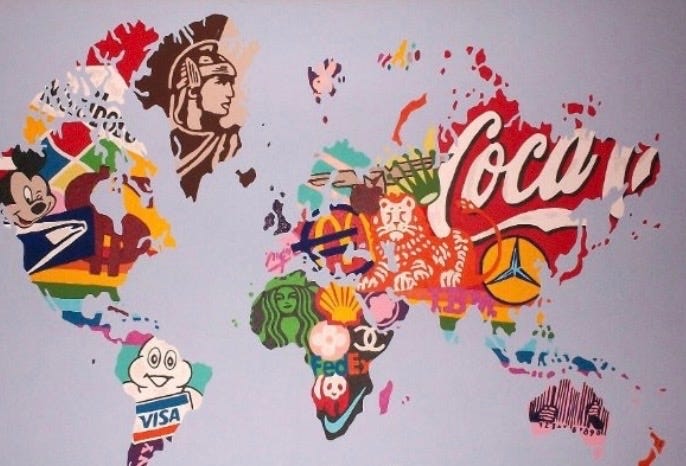
Are we the slaves of consumerism? In earlier times than ours the conquering of new lands was the norm. We expanded our borders and often in dramatic ways later romanticized by history. The most famous example is probably the conquering and colonization of the American west in the middle of the nineteenth century. As we all know, “The Frontier” soon came to an end. In 1874 a man by the name of J.F. Glidden from Illinois began to sell barbed wire. Thereby the farmer had the opportunity to wall-in and protect his plot of land at a greatly reduced cost and the Wild West was no more. The attention of Western people was then turned away from the quest for virgin earth. We also found many other uses for barbed wire.
Every activity in which we partake is in one way or another tied to a piece of the earth, most often expanding an inhabited area on this plot of land or by that body of water. This means human activity constantly demands new land, or when there is no new land it demands a more intensive use of existing land. A point often inspired by the indigenous peoples of the world is that these demands can only be met if the earth is used in a more efficient and sustainable way.
One common reaction to our modern achievements proclaims that we have fulfilled the dreams of our pioneers. Utopia is actually a place and time on our maps of meaning. We say: It was for this day that man and woman dreamt and for which they worked. Lifestyles have been steadily improving. The endless work for Liberty, Equality and Fraternity has been successful. The chimes of freedom have rung out poverty and rung in a new golden age of material wealth. But was this the utopia we were promised? Or is there still a better utopia, somewhere, out there?
There is. But we should always be careful to criticize our latest achievements as the product of some soulless materialism. There is, of course, some truth in the critique about an overemphasis on material goods, but the person who complains about materialism is often the same person for whom welfare and high standards of living have always been a banal reality. It’s easy to forget that for many people they can and do represent a considerable personal liberation, a new possibility for human contact and experiences that lead to a greater and richer life.

Elements of Liberation
———————————-
What is liberation? Perhaps we often forget what it takes to achieve authentic liberation. It is the fruit of human consciousness, truth and right, interdependence, citizenship, and above all – time. This combination is as necessary as it is rare. Perhaps we too readily admire our freedoms forgetting that they are a privilege.
We should never turn a blind eye to the connection between economic conditions and liberation. Freedom of expression, that is, freedom from imprisonment for one’s opinions is a great thing, an essential goal, but does it mean anything if the free-thinker goes to sleep hungry and impoverished?

Searching for the Way
—————————–
What is the true and right way? We cannot remain indifferent to the problems of the world, such as hate and destruction. Indifference turns hopeful optimism to devastation. International questions come to meet us in our living rooms, our town squares and in our hands. They make us conscious about the world and force us into conversation. We reach out into the world and the world reaches into us.
One of history’s greatest debates about indifference occurred in 1550 in Spain, remembered as the famous Valladolid debate, between Bartolomé de las Casas and Juan Ginés de Sepúlveda. The contrasting views between a monk and bishop of Chiapa and a learned humanist, turned into a debate about whether the Europeans’ actions when they explored the New World were morally justifiable or not. Spanish priests and intellectuals looked at the Spanish maritime empire and began to ask themselves, on the basis of their Christian beliefs, if they were justifiable according to Catholic teaching.
The lively debate lasted over a year and the result was that the native people they encountered also had souls and spirit. Or call it human consciousness. Since they had this quality there were certain things one could not do to them and many things one had to do for them. This is the root of human rights. A conscious soul is what makes us all into equals. We are all different when it comes to beauty, wealth, social position and talent. But what cannot be denied is that our individual souls are equal. This is why political consciousness is fundamental, because it means that all people in the world regardless of race, color, sex, or religion, have soul and spirit. This also means freedom. As each person is independent with inalienable rights, their individual freedom is defended by our interdependence.

5. Mercy: The True Way
—————————–
What is mercy? Mercy is the face of love. To oppose despair and work for hope is not just a material benefit, it is mercy in action. Mercy is solidarity. It inspires practical changes which change the way we look at each other, value one another.
Mercy is not only a matter of loving our neighbor. Public relationships, political organizing, is an iconic image of love for the world. When we can live into that image, then we are ready to enter into a City of Love.

To Serve and to Share
—————————–
What is serving and sharing? There is an old Roman saying which states, “That which concerns all, should be decided by all.” That’s the democratic ideal. A City of Love is to will something for the good of the other. It is to will a social change, because such a change gives a promise of improvement.
The Politics of Love has the audacity to propose that all of life should be understood within the broader framework of love. Democratic relationships need to be contextualized within the framework of charity, less they devolve into manipulation. Our entertainments and recreations need to be conditioned by love, less they devolve into self-indulgence.

7. Light and Joy = Liberation
———————————
A City of Love proposes that the light of solidarity and the joy of individuality is liberation and fraternity. Can we present to the world what our culture has produced through a fruitful tension between spirituality and worldliness, faith and humanism, morality and law, order and freedom? We must be courageous enough to integrate our children into this and to show our willingness to uphold and expand it.